.jpg)

Save and download ads from Facebook Ad Library by finding the advertiser's ad, saving a reference through the Denote extension, then using an available download action if you need a local file. Confirm the saved creative and retain its source link before moving on.
Updated October 16, 2026. Saving a reference and downloading its media solve different tasks: the reference preserves research context; the file supports offline inspection. This guide keeps the original Facebook Ad Library task and shows how to turn the result into a useful creative note.
TL;DR
- Find the right advertiser and ad in Meta Ad Library.
- Use the Denote extension's save action and confirm the reference in your workspace.
- If you need offline media, use the download action available for the saved creative or supported source.
- Record the opening, promise and proposed test instead of keeping an unexplained file.
Before you save and download ads from Facebook Ad Library
Facebook Ad Library is commonly referred to as Meta Ad Library. The public library and its API are different interfaces; “Meta Ad Library” does not mean “Facebook Ad Library API.” Use the public Meta Ad Library for this workflow.
The library lets you inspect public advertising information. Available fields vary by ad category and region. Do not assume a normal commercial ad exposes the advertiser's complete spend, targeting or conversions. Meta's Ad Library Report concerns social-issue, election and political advertising rather than a general billing report for competitors.
Prepare the advertiser name, intended market and the type of reference you need. A question such as “How does this brand show product use?” helps you choose which ads to retain.
Step 1: Find the advertiser and verify the ad
Open Meta Ad Library, choose the relevant country and ad category, and search for the advertiser. Check the Page identity so you do not confuse similarly named brands or local branches.
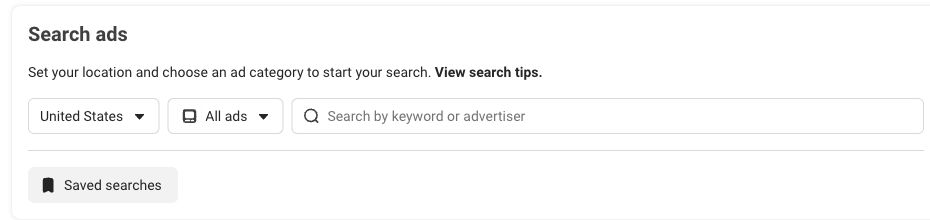
Product screenshot: Meta Ad Library, captured October 14, 2026. United States and All ads are selected before searching for an advertiser.
Inspect the creative, visible copy and destination information. Keyword search can help discover a category, but a keyword result is not a complete view of one advertiser. Record the source URL or library identifier where available, the advertiser name and the date you observed it.
For a brand-focused process, see how to find competitor Facebook ads.
Step 2: Save the reference with the Denote extension
Install the official Denote extension from the Chrome Web Store. Return to the library tab and sign in to Denote if the save flow requests it.
Use the Denote save control on the ad you want to retain. Choose the intended collection when that option is presented, then open your Denote workspace to confirm the saved reference. A collection such as Competitor product demonstrations is more useful than a folder called Downloads because it explains why the ads belong together.
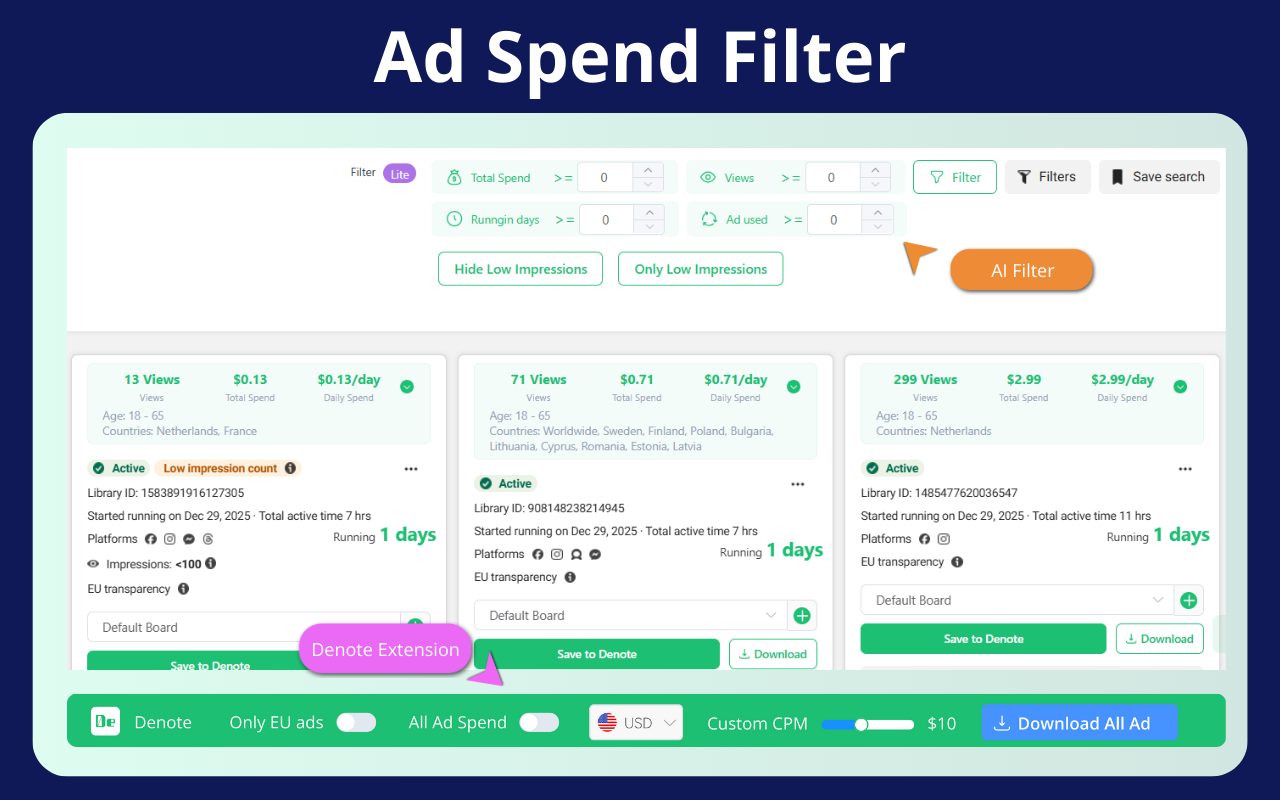
Publisher-supplied interface example from the official extension listing, retrieved October 14, 2026. Save to Denote and Download are separate actions. The displayed amounts are estimates, not verified advertiser spend.
Check that the saved item is the correct creative and that the source information you need is available. Where a field is missing, keep it in your own research note rather than assuming every source supplies identical metadata.
Denote's Swipe File describes the collection workflow. Saving is the point to check the result, before you rely on it in a brief.
Step 3: Download media when you need it offline
Open the saved creative and use the download action offered for that item. On a supported source page, the extension may also present a direct download control. The exact available action depends on the creative, source and account access.
After the file is returned, open it and check that it contains the intended video or image. A carousel can have several assets; inspect which asset was exported rather than assuming a single file represents the whole ad.
Keep the source link and context alongside the file. The media alone may omit the advertiser identity, ad copy, capture date or destination. Those details matter when the team later asks what the reference actually demonstrated.
If no download action is available, retain the accessible reference and note the missing export. Do not describe the task as completed just because you copied a link.
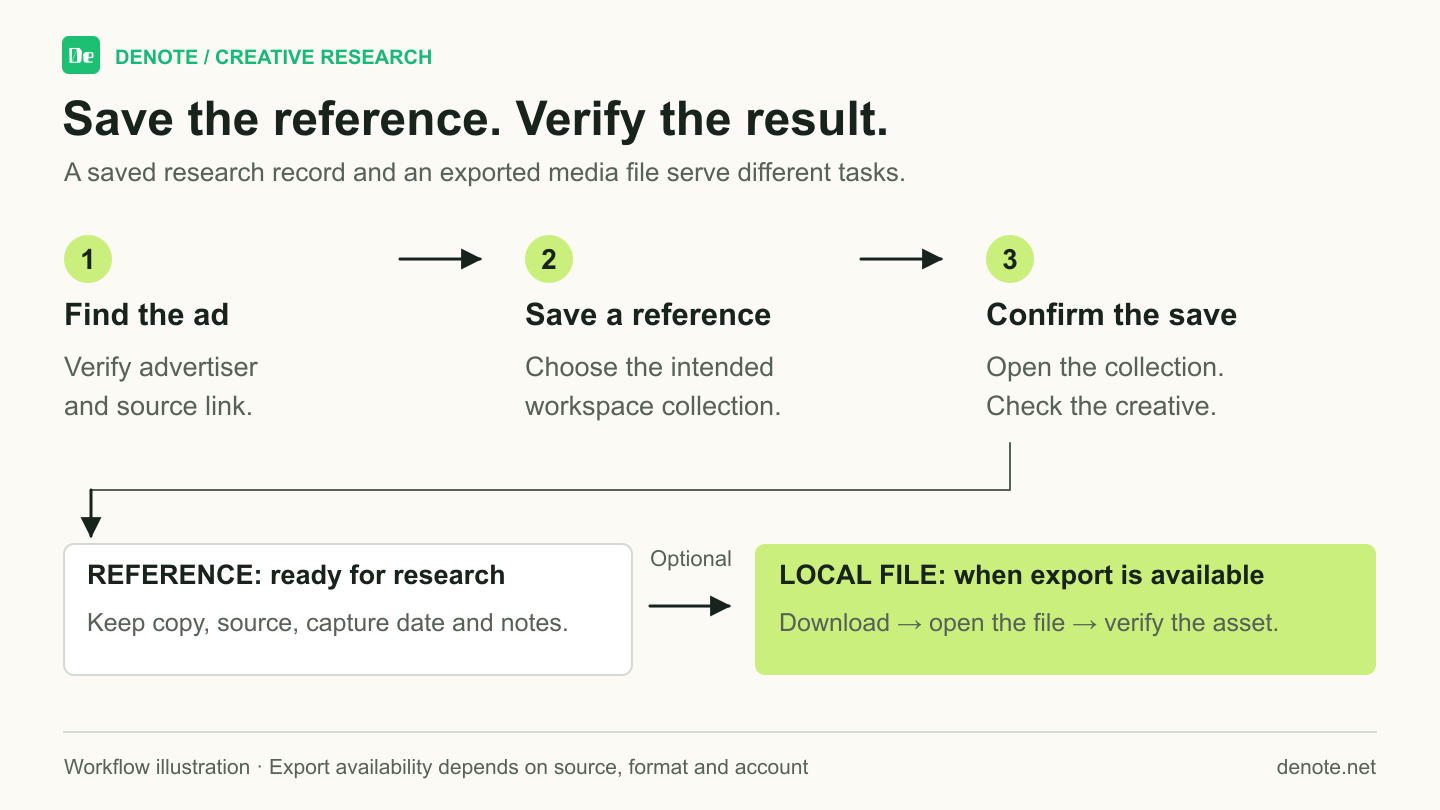
Workflow illustration: confirm the saved reference first. When export is available, open the file and check the asset; retain the source context alongside it.
Troubleshoot saving or downloading a Facebook ad
These checks address the collection workflow. They do not guarantee every ad source or media format can always be exported.
Turn the saved Facebook ad into a research note
Use this compact record after you save and download ads from Facebook Ad Library:
A fictional example: an ad shows a cleaning tool working on one small surface before introducing the offer. You could test an earlier demonstration using your own footage and product. You cannot conclude that the reference advertiser is profitable from the demonstration or its observed run length.
Use the ad creative analysis worksheet for the full breakdown. For a Facebook competitor review, Denote Ad Spy provides a relevant next starting point.
Questions about Facebook Ad Library downloads
Can I right-click every ad and choose “Save Video As”?
Do not rely on that as a universal method. The available browser actions depend on how the source delivers the media. Use the supported save/download flow and confirm the actual result.
Does an exported ad show the competitor's performance?
The file shows the creative. It does not establish the advertiser's spend, audience settings, purchases or ROAS. Any estimate must retain its provider definition and scope.
Can I republish the reference in my own campaign?
Saving or exporting a reference does not establish reuse rights. Analyze the creative mechanism and produce your own assets and claims.
Save and download ads from Facebook Ad Library when the reference serves a clear purpose. Keep its source context, write the observation, and move the team toward an original test through Denote's research workflow.


