.jpg)
If you regularly browse the Meta Ad Library, you may have noticed something new sitting quietly beneath certain active ads: “low impression count.”
At first glance, it looks harmless. Maybe even ignorable.
But in 2026, low impression count is no longer just a label — it’s a signal. And like most signals inside Meta’s ecosystem, the people who understand it early gain an edge, while everyone else scrolls past it.
This guide breaks down how to use low impression count in Meta Ad Library properly — not as a red flag, but as a lens. A way to see ads earlier, think clearer, and test smarter before markets become crowded.
What “Low Impression Count” Means in Meta Ad Library
A New Visibility Label on Active Ads
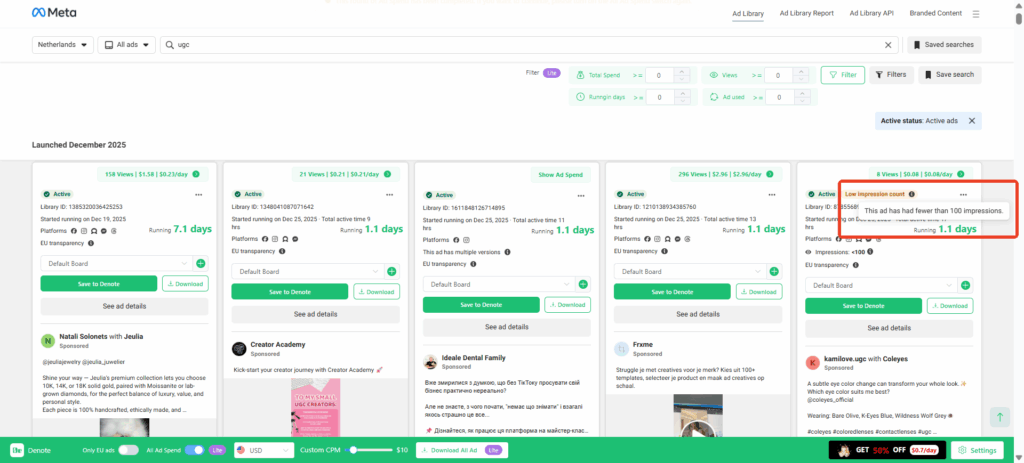
Meta recently introduced low impression count as a visibility label inside the Meta Ad Library. You’ll see it attached to ads that are technically active but have received very few impressions — often under a few hundred.
This applies even when:
- The ad is approved
- The campaign is live
- The advertiser is spending money
In other words, the ad exists, but Meta isn’t delivering it at scale.
This update quietly changes how we should read the Ads Library. Before, any “active” ad looked equally legitimate. Now, Meta draws a clear line between existence and distribution.
Active Ads vs. Delivered Ads
A lot of people mix up “active” with “successful” when it comes to ads. But just because an ad’s active doesn’t mean it’s making an impact. You can have an ad that’s technically running but hardly gets seen, or another one that’s live and getting pushed everywhere. That’s where the “low impression count” label comes in—it helps tell these two apart.
Picture a restaurant menu. Just because a dish is listed doesn’t mean anyone’s actually ordering it. The real story comes from what the kitchen’s actually sending out. Same deal with ads. If an ad has a low impression count, it just means Meta hasn’t decided it’s worth showing to more people—at least not yet.

How Meta Signals Delivery Confidence Through This Label
Meta’s ad system runs on confidence. Confidence in targeting. Confidence in relevance. Confidence in predicted outcomes.
When an ad shows a low impression count, Meta is essentially saying:
“We’re not convinced enough to push this yet.”
That uncertainty is exactly what makes low impression ads interesting — especially for researchers and advertisers who know what to look for.
Why Meta Introduced the Low Impression Count Label
Improving Transparency Inside Ads Library
For a long time, people using the Ads Library just guessed how ads were doing based on how often they showed up. If you kept seeing an ad, you figured it was working. Meta’s new update changes that.
Now, you can see when ads are stuck, getting throttled, or pushed down because they’re not performing well. This kind of transparency actually helps everyone—advertisers, analysts, even businesses checking out the competition. It keeps you from confusing an ad just being visible with it actually doing well.
Preventing Misinterpretation of Competitor Ads
Without this label, competitor research often leads to false conclusions:
“They’re running this ad, so it must be profitable.”
In reality, many competitor ads are:
- Test creatives
- Budget-limited experiments
- Early drafts that never scaled
Low impression count clarifies that difference. It doesn’t tell you what’s winning — but it tells you what’s still being evaluated.
What Changed Compared to the Old Ads Library
Previously:
- Active ads looked equally credible
- Early test ads blended with scaled campaigns
- Analysts had to guess delivery status
Now:
- Low delivery is visible
- Early-stage ads stand out
- Interpretation becomes more nuanced
This makes how to use low impression count in Meta Ad Library a real skill, not just a metric.
How Ads End Up With Low Impression Count
Understanding why ads get low impressions is critical before using them strategically.
Limited Audience or Over-Restricted Targeting
One common cause of low impression count is overly narrow targeting. This includes:
- Small geo areas
- Stacked interests
- Tight demographic filters
When Meta can’t find enough eligible users, delivery stalls — even if the creative is strong.
Low Budgets in Competitive Auctions
In competitive markets (especially US-based niches), budget matters. A $10/day test ad competing against $500/day campaigns is unlikely to win impressions. The result? Low impression count — not because the ad is bad, but because it’s underfunded.
Learning Phase and Weak Early Optimization Signals
New ads start blind. Until Meta collects enough signals (clicks, engagement, conversions), delivery remains cautious. Early negative feedback or low engagement can slow impressions further.
Common Scenarios Where This Label Appears
You’ll frequently see low impression count on:
- Newly launched campaigns
- Creative testing ads
- Local service ads
- Narrowly targeted offers
Recognizing these scenarios prevents overreacting to the label.
Which Ads Are Most Likely to Show Low Impression Count
Newly Launched Test Ads
Most test ads start with low impressions. That’s normal. Smart advertisers intentionally run multiple low-impression tests to validate angles before scaling. For researchers, this is gold — you’re seeing ads before results distort creativity.
Local Service Ads in Competitive Markets
US local services (plumbing, roofing, legal, dental) are especially prone to low impression count. Competition is fierce. Budgets are uneven. Many ads get stuck before meaningful delivery. This makes low impression ads common — and informative — in these niches.
Early-Stage Creative Experiments
Raw ideas show up early. Before branding polish. Before optimized hooks. Before landing pages are refined. Low impression count ads often reveal the thinking stage of competitors — not the final output.
How to Use Low Impression Count in Meta Ad Library for Ad Research
This is where low impression count becomes powerful.
Identifying Early-Stage Test Ads
Low impression count often marks ads that are:
- Recently launched
- Still being evaluated
- Not yet optimized
These ads show what competitors are experimenting with, not what they’ve already validated. That timing advantage matters. By the time an ad is scaled, the angle may already be saturated.
Understanding What Competitors Are Still Testing
Ask better questions when analyzing low impression ads:
- What hook are they testing?
- What audience are they exploring?
- What offer structure appears?
You’re not copying performance — you’re studying direction.
Creative Signals Worth Analyzing Even With Low Impressions
Pay attention to:
- Opening lines
- Visual patterns
- Emotional triggers
- Call-to-action phrasing
These elements often survive into winning ads, even if early versions don’t. Tools like Denote make this process easier by helping you organize, compare, and revisit low impression ads across markets instead of relying on memory or screenshots.
Using Low Impression Ads to Improve Creative Testing Strategy
Low impression ads shouldn’t be judged. They should be mined.
Extracting Creative Angles Instead of Copying Results
Most people look for “winning ads.” Smarter advertisers look for winning hypotheses. Low impression count ads are unfinished thoughts — drafts, not conclusions. They reveal why someone believed an angle might work. That insight is far more valuable than copying a polished ad.
Testing Before the Market Becomes Saturated
When everyone copies scaled ads, CPMs rise and attention drops. Low impression research lets you:
- Test earlier
- Experiment cheaper
- Learn faster
This is how you stay ahead instead of reacting.
Why Raw Creatives Often Appear at Low Delivery Stages
Before Meta’s system optimizes delivery, creatives are often:
- More honest
- Less over-engineered
- More idea-driven
Those raw signals disappear once performance data takes over.
Common Misunderstandings About Low Impression Count
As powerful as the low impression count label is, it’s also easy to misuse. Most mistakes don’t come from ignorance — they come from over-interpretation.
Low Impression Count Does Not Mean a Broken Ad
The most common reaction to seeing low impression count is panic:
“This ad must be failing.” “Meta doesn’t like it.” “It’s probably trash.”
That assumption is wrong. A low impression count just means Meta hasn’t really started showing your ad yet. It doesn’t mean your creative’s bad, unapproved, or doomed. Honestly, some of the best campaigns kicked off with hardly any delivery at first.
Meta’s system likes to hold back before throwing budget behind something new, especially when the auctions get crowded or the creative’s brand new. Calling low impression ads “bad ads” is like deciding a movie’s a flop after one private screening. It’s way too soon to judge.
Why Low Delivery Does Not Equal Poor Performance
Delivery and performance go hand in hand, but they're not identical. Sometimes you get low impressions even if your click-through rates look good, people are engaging, or conversion signals are just starting to show up. Meta doesn’t care about potential—it wants confidence. And confidence comes from time, enough data, and clear signals.
That’s why seasoned advertisers don’t panic when impressions are low. Instead, they dig into what’s slowing down delivery. They don’t question if the idea is worth testing—they just want to know why it’s not moving faster.
Ignoring Context Leads to Wrong Conclusions
Context matters more than labels. Before judging a low impression ad, always ask:
- How old is the ad?
- What market is it in?
- How restricted is targeting?
- What’s the budget relative to competition?
An ad with low impression count in a hyper-competitive US local niche tells a very different story than one in a broad global ecommerce campaign. Ignoring context turns a useful signal into noise.
A Practical Workflow for Using Low Impression Count Signals
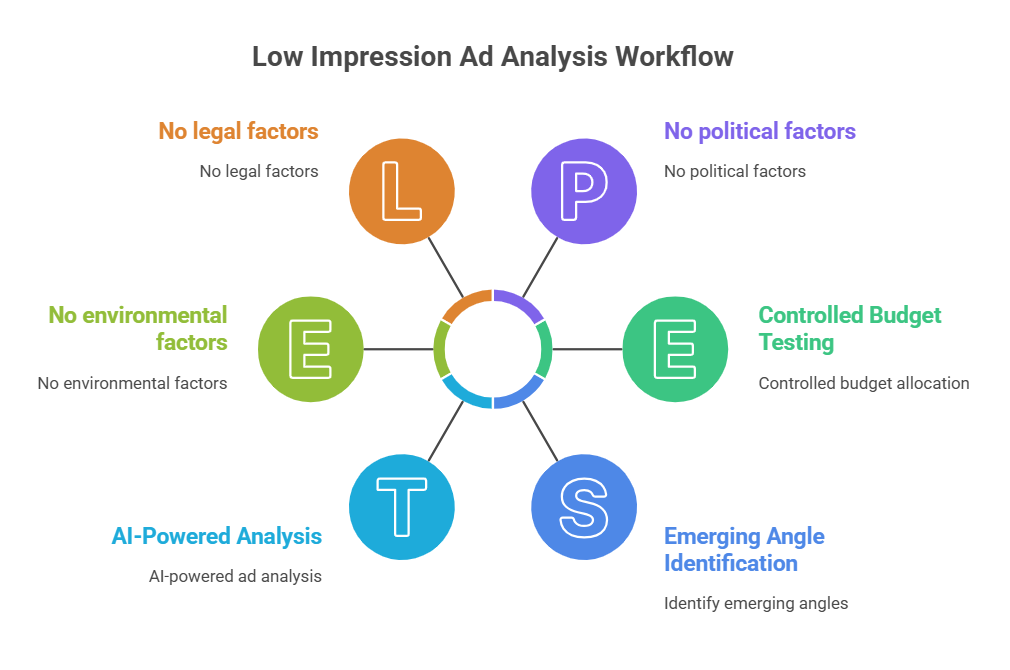
Understanding low impression count is helpful. Using it systematically is where it becomes powerful. Below is a practical, repeatable workflow you can apply whether you’re researching competitors, planning creatives, or validating new angles.
Step 1: Filter Ads by Intent, Not Exposure
Instead of asking, “Which ads are getting the most impressions?” ask, “Which ads are being tested right now?”
Low impression count helps you isolate:
- Fresh experiments
- Early hypotheses
- Directional bets
This shifts your mindset from copying results to studying intent. When scanning Meta Ad Library, low impression ads often reveal what advertisers believe might work next — before the market reacts.
Step 2: Analyze Creative Direction, Not Metrics
Metrics lie early. Creatives speak sooner. When reviewing low impression count ads, focus on:
- The core promise
- The emotional trigger
- The framing of the problem
- The offer positioning
Ignore vanity metrics. Look for patterns. If multiple advertisers are testing similar hooks with low delivery, it’s rarely coincidence. It’s usually a sign of emerging angles.
This is where organizing insights matters. Tools like Denote help you group low impression ads by theme or angle, making it easier to spot repetition across brands without relying on memory.
Step 3: Validate Ideas Through Fast Testing
Low impression count research is not about copying. It’s about reducing uncertainty. Once you identify promising angles:
- Test them quickly
- Keep budgets controlled
- Watch early engagement signals
The goal isn’t scale — it’s clarity. Fast testing turns low impression insights into decisions before competitors commit real spend.
Why Low Impression Count Is a Competitive Advantage in 2026
In 2026, speed matters more than polish. Markets saturate faster. Creatives fatigue sooner. Angles burn out in weeks, not months. This makes low impression count one of the most underappreciated signals in Meta Ad Library.
Seeing Ads Before the Crowd Does
You can spot high-impression ads from a mile away. They’re everywhere, and honestly, everyone’s trying to do the same thing. But low impression ads? They fly under the radar. They show up before anyone’s really paying attention—before you start tweaking, before the competition even knows what’s happening.
That early window matters. It lets you jump into new markets ahead of the crowd, try out ideas without burning through cash, and sidestep whatever creative trend everyone else is chasing. In ad research, showing up early usually matters way more than nailing every detail.
Understanding Process, Not Just Outcomes
Most people study outcomes:
- High impressions
- Long runtimes
- Visible spend
Smart advertisers study process. Low impression count shows you the messy middle:
- What ideas didn’t get immediate approval
- What hypotheses advertisers are still exploring
- How creative thinking evolves before performance locks in
This process insight is hard to fake — and impossible to see once ads are fully optimized.
Why This Matters More Than Ever
Meta doesn’t reward activity. It rewards signals. And signals form quietly. Low impression count is Meta telling you, “This ad is still being judged.” If you learn to read that moment correctly, you gain information before the system — and the market — settles on a verdict.
Conclusion
A window into early creative thinking, untested hypotheses, and emerging market directions. When used correctly, low impression count in Meta Ad Library helps you spot early-stage ads before saturation, improve creative testing, avoid false assumptions about competitors, and make faster, smarter decisions in 2026.
The biggest mistake is ignoring it. The second biggest mistake is overreacting to it. Treat low impression count as a signal, not a verdict. Study it, add context, and test around it. And if you want to work efficiently at scale — across markets, angles, and timeframes — tools like Denote can help you capture these early signals before they disappear.