.jpg)
Ad creative analysis breaks an ad into its opening, promise, demonstration, proof, offer, and destination so your team can decide which idea to test. The most useful output is a brief that separates observable details from assumptions about why they might work.
For competitor research, start with the creative itself. For your own campaigns, add performance data from your advertising and business systems. Those are different evidence sets: a public reference can inspire a hypothesis; your own results determine whether that hypothesis helps your business.
TL;DR
- Choose a relevant reference in an ad library or TOP AD chart and record where you found it.
- Describe the creative before interpreting it. “Shows the product immediately” is an observation; “improves conversion” needs outcome data.
- Complete the worksheet below, then write one hypothesis and one meaningful variable to test.
- Use your own campaign results for performance analysis. Competitor popularity and run length are discovery signals.
Method note: The worksheet is an editorial framework. The completed example is fictional and makes no claim about an actual advertiser, chart rank, or measured uplift.
Start ad creative analysis with the decision
Define what the analysis will help you choose. You might need an opening for a new product demonstration, a clearer explanation of a game mechanic, or a different way to present an offer. “Find good ads” is too broad to guide production.
Write the intended viewer, the product benefit you can substantiate, and the next action. Then select a reference addressing a comparable problem. An impressive visual treatment from an unrelated category may be interesting, but it can be a poor basis for your next campaign.
Use Denote Top Ads when a weekly Game or Tool creative shortlist fits the task. The public chart offers Trending, Rising and New views; record which one you used. Use Denote Ad Library for a broader search, or Ad Spy for Facebook competitor context. These are starting points for inspection, not substitutes for reading the ad.
A practical ad creative analysis worksheet
Copy this table into your team's working brief. Leave an unavailable field marked unknown rather than filling it with a plausible guess.
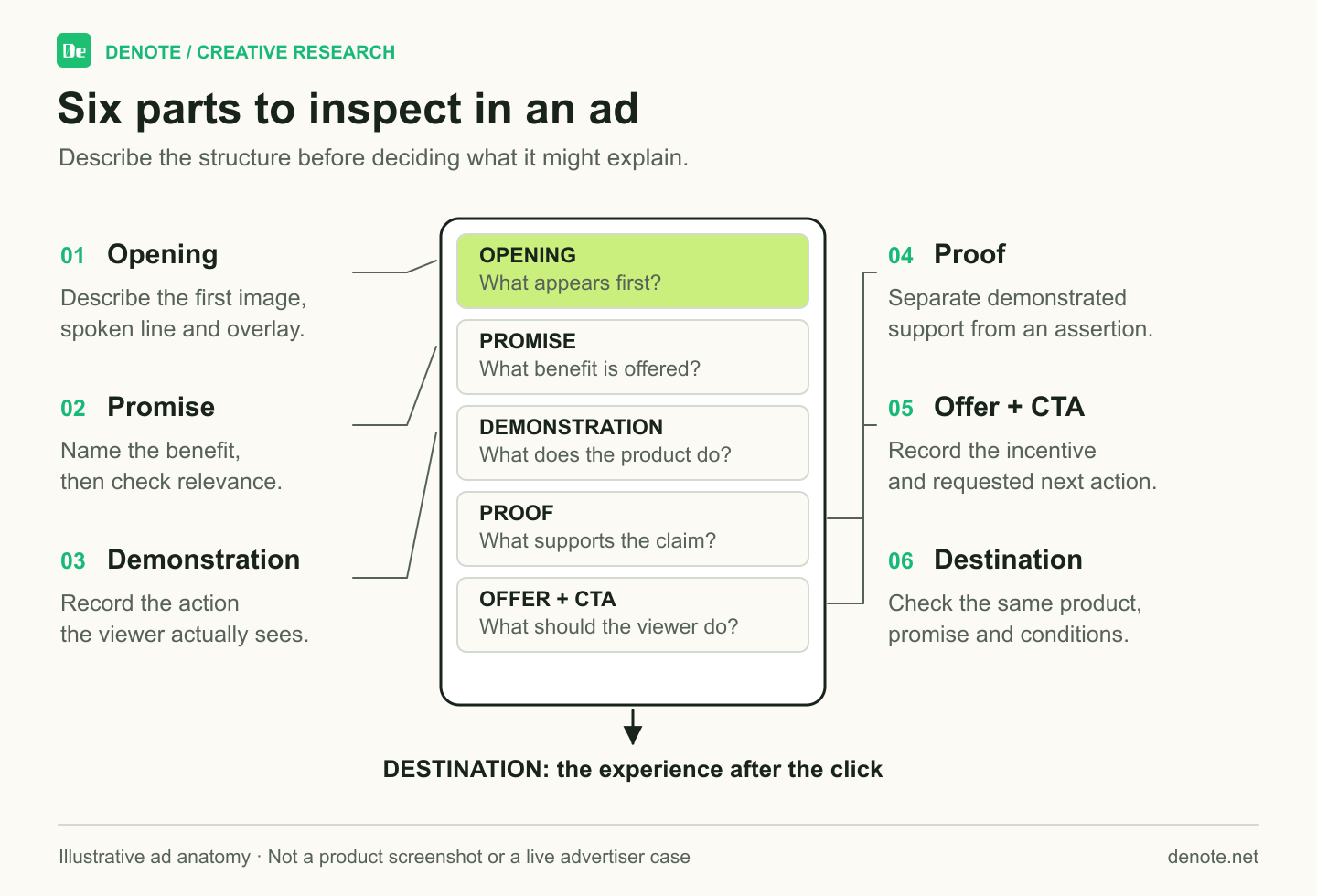
Illustration: inspect the six parts of the creative and its destination before writing an explanation of how it might work.
Do not equate an audience cue with the advertiser's actual targeting. A student in the video may suggest a student-related situation; it does not disclose the campaign's audience settings.
Complete the worksheet in three passes
Pass one: inspect the opening without sound
Record the first meaningful image and any text. Note whether the product, problem or payoff appears first. Describe the sequence precisely enough for an editor to storyboard it.
Avoid writing “strong hook” as the entire observation. “A player makes a visible mistake before the solution appears” gives a team a mechanism it can discuss. “Strong hook” gives it a judgment without evidence.
Pass two: inspect the full message
Listen to the narration and compare it with the visuals. Identify the benefit, how the product is demonstrated, and which moment supports the main claim. Note whether the offer appears in speech, caption or end card.
If a platform exposes relative engagement over time, record that measure separately. TikTok's Top Ads analytics can help locate engagement moments, but the graph does not by itself explain their cause. TikTok's dashboard documentation
Pass three: inspect the destination and limits
Check an accessible landing page for the same product, offer and next action. If the page is unavailable or has changed, note the date and limitation. You can analyze the visible video while leaving the destination field unresolved.
For a TOP AD reference, keep the popularity measure, chart week and scope in the source record. A display/impression estimate is a provider estimate, and neither that figure nor a chart position establishes conversion rate or profit. Do not merge fields from different providers into a single “performance score.”
A completed ad creative analysis example
Imagine a fictional mobile puzzle game called Tile Trail. Its reference concept shows a nearly finished puzzle, an obvious wrong move, a quick reset, and a successful solution before a play prompt. This is a constructed example for the worksheet.
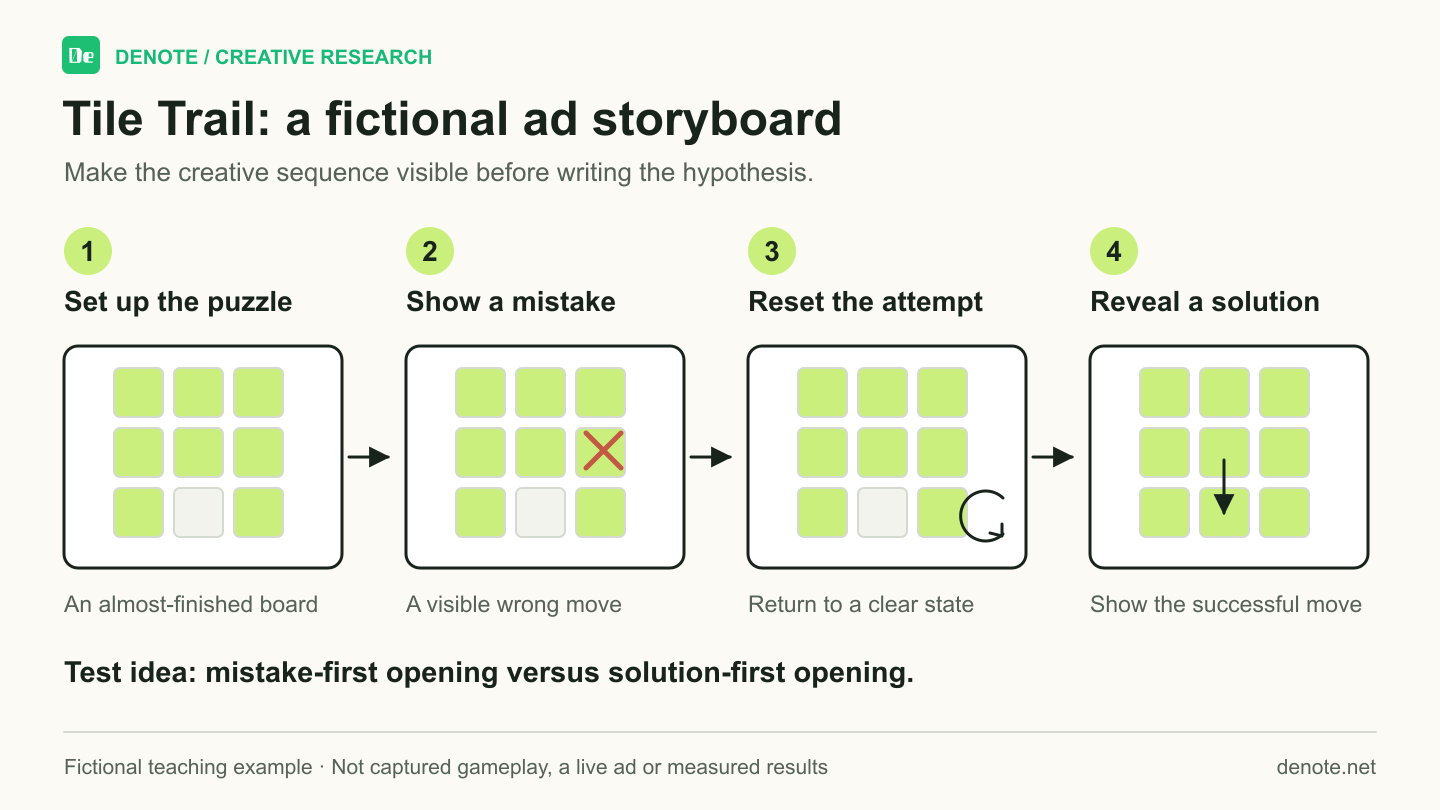
Fictional storyboard: a teaching example for the worksheet, not captured gameplay or a real ranked ad. It suggests an opening-sequence test; it reports no results.
This analysis produces a specific production decision: make two opening sequences. It does not conclude that mistake-first ads acquire better players.
For a physical product, the same worksheet might compare problem first with demonstration first. Keep the reference's mechanism while rebuilding the creative around your own product, evidence and audience.
Convert ad creative analysis into a test brief
Use this compact handoff:
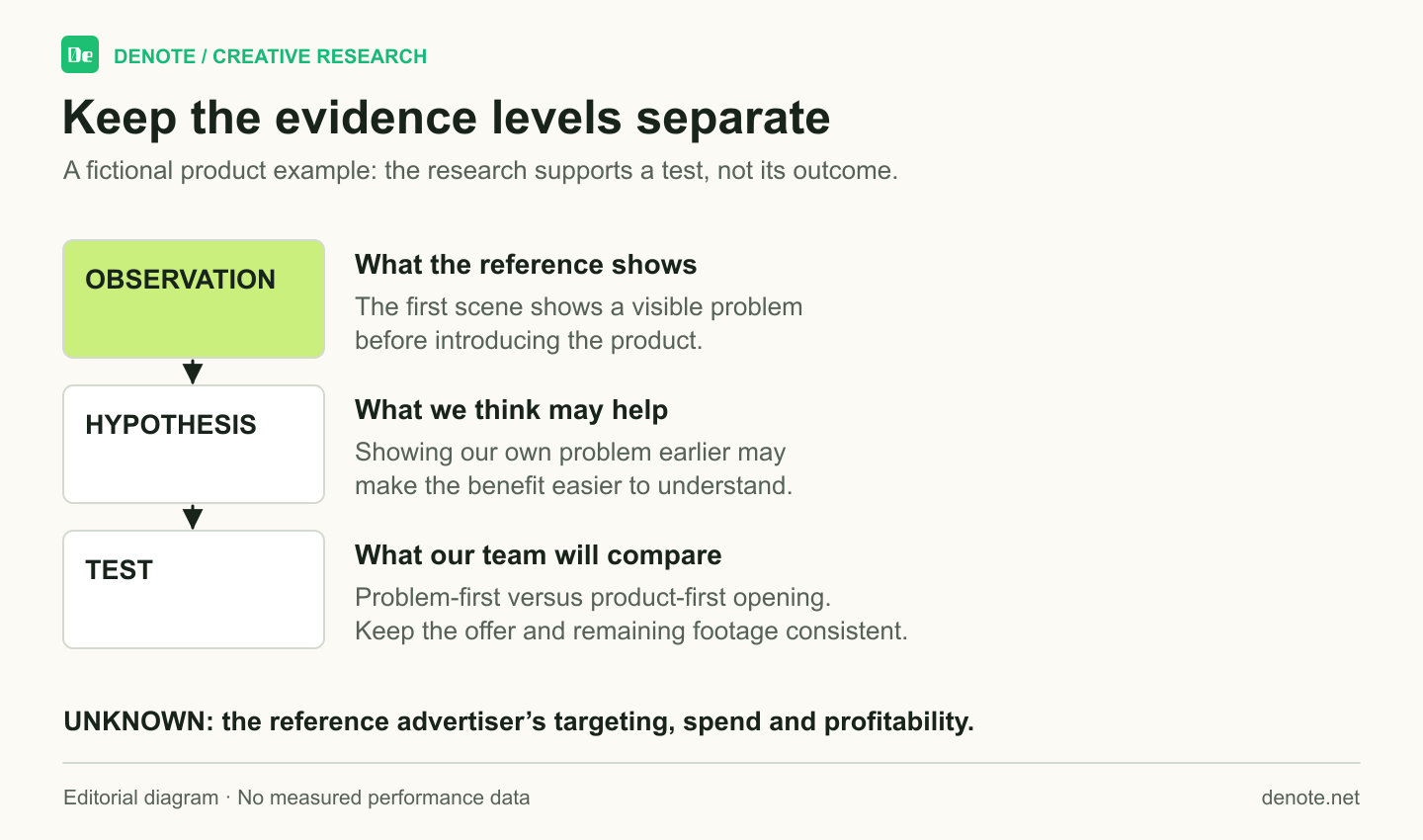
Illustration: an observation can justify a hypothesis and an original test. It cannot establish the reference advertiser's targeting, spend or profitability.
Observation: State a visible sequence or message.
Hypothesis: Explain what that sequence might help our viewer understand.
Execution: Describe our original footage, copy and substantiated promise.
Variable: Name the one meaningful difference between versions.
Keep consistent: List the offer, remaining footage, destination and relevant campaign settings.
Evaluation: Choose our own outcome measure, review window and decision rule.
Unknowns: Record the reference's missing evidence.
Choose the evaluation rule before seeing results. If the objective is purchases, a more engaging opening is useful only if it helps the relevant downstream outcome. For an app, a cheap install may still bring users who do not activate or return. Your business context decides which result matters.
Our ad brief guide covers the wider production handoff. The worksheet here supplies its research rationale.
Compare patterns without inventing certainty
Analyze several relevant references using the same fields. Group them by opening mechanism, demonstration and proof rather than by whether you personally like them. Count unique creatives within your inspected sample and keep repeated variants together.
A finding such as “demonstration-first openings appeared in several references we reviewed” describes that sample. It does not establish the category's most successful format. Record how many references you inspected and how they were selected before reporting a frequency.
With your own campaigns, connect creative versions to results and check that the comparison conditions support the decision. Public competitor research and first-party performance analysis can inform each other, but one cannot stand in for the other.
Make the next creative decision clear
Useful ad creative analysis ends with a source, a precise observation, an honest unknown and a test your team can produce. Open Denote Top Ads for a relevant weekly Game or Tool reference, or Denote Ad Library for broader discovery. Complete one worksheet before adding more ads to the shortlist.


