
Updated November 6, 2026.
The right Trendtrack alternative depends on which part of your research you need to replace. For a workflow connecting Shopify store context with ad research and brand tracking, consider Denote. For storefront inspection, consider Koala Inspector. For traffic estimates, evaluate Similarweb. For search visibility, look at Semrush. For direct public ad lookup on Meta, use Meta Ad Library.
These tools overlap, but they do not provide identical data or replace every part of Trendtrack. Start with the decision you need to make, then test the relevant stores and advertisers before choosing a tool.
Quick comparison
| Alternative | Research task to evaluate | Useful output | Main limitation to check |
|---|---|---|---|
| Denote | Connect Shopify store context with ads and brand tracking | Store-led creative research and saved references | Store coverage and advertiser matching |
| Koala Inspector | Inspect a Shopify storefront | Product and technology observations | Detection accuracy and estimated fields |
| Similarweb | Compare website traffic and markets | Traffic trends and audience geography | Coverage for small stores and metric scope |
| Semrush | Research organic search visibility | Search competitors, keywords, and pages | Organic estimates are not total store traffic |
| Meta Ad Library | Look up public Meta ads | Advertiser and creative references | Platform scope and limited research organization |
The order follows research tasks, not an overall performance score. A tool that works well for traffic analysis may be a poor substitute for organizing a creative review.
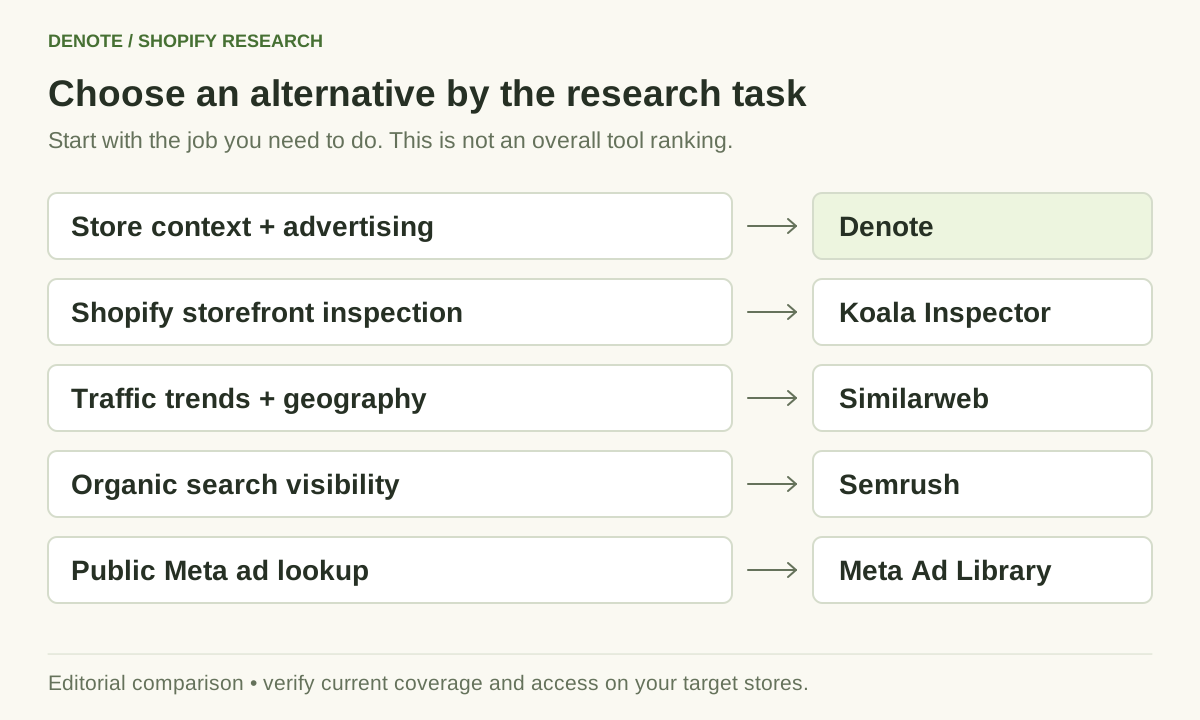
Choose by research task. This map does not rank overall performance or guarantee coverage.
How this comparison was prepared
This guide uses public product descriptions and documentation reviewed on November 6, 2026, and the Denote workflow described below. It is a workflow comparison, not a hands-on benchmark of paid accounts. It does not rank data accuracy, claim measured ROI, or assume that every advertised field is available for every store.
Exact prices, credits, and access limits change and are not used to determine the recommendations here. Check the current plan and try a representative sample of stores before buying. Keep vendor source URLs in your internal evaluation notes so that the team can revisit the claims it relies on.
What are you trying to replace in Trendtrack?
Trendtrack presents a broad ecommerce research workflow spanning stores, advertising, brand tracking, emails, and saved research. If you use several of these together, replacing one feature may leave a gap elsewhere.
Write down the tasks you actually perform. For example:
- Find a comparable store and understand its positioning.
- Inspect the products and offers it promotes.
- Review available traffic trends and countries.
- Find relevant ads and follow their landing pages.
- Save examples and return to a brand over time.
Then mark which tasks are essential and which are occasional. If you only need a few public ads for a creative meeting, a broad market research subscription may be unnecessary. If you monitor many stores, coverage, freshness, and repeatable organization become more important.
1. Denote: for connecting store research with advertising
Evaluate Denote when your research starts with a Shopify store and should end with useful advertising references. Its Shopify store overview brings together basic store information, available traffic history and top countries, and advertising context. From the store, move into relevant ads, inspect their landing pages, and use Track Brand to revisit the brand's advertising.
This fits a creative workflow: identify a relevant store, understand its market context, choose an offer or message to study, and save the examples behind your next brief. A traffic increase can help prioritize a review, while the ad and product page show what the brand is communicating.
Example task: You sell travel accessories and want to understand how comparable brands demonstrate packing benefits. Start with stores in a similar price range, review the available store context, and collect ads under distinct messages such as capacity, organization, or convenience.
Check before choosing: Confirm the store-to-advertiser match, which platforms and periods are covered, and whether the saved research workflow fits your team. Missing ad or traffic coverage should remain visible in your notes.
Boundary: Public ad observations and traffic estimates do not reveal private sales or ROAS. Store research also does not automatically establish a product's sales rank or provide a complete price history.
Use the Shopify competitor analysis guide for a complete workflow, or review Track Brand when ongoing ad research is your main requirement.
2. Koala Inspector: for inspecting a Shopify storefront
Evaluate Koala Inspector when you already have a store in mind and need to examine its storefront context. Its public product description emphasizes Shopify store inspection, including products, apps, themes, traffic, and advertising information.
Example task: You discover a store with a useful bundle presentation and want to understand its catalog and visible storefront setup. A browser-based inspection workflow can help you collect the initial observations while you review the store.
Check before choosing: Test a few stores whose products or setup you know. Note which fields the tool identifies, which are estimates, and which are unavailable. A tool's ability to display a field does not establish that the field is complete or current for every store.
Boundary: An app or theme identification does not explain why the store converts. Product lists and estimated metrics also need interpretation. Pair inspection with the actual product page and a dated research note.
If your immediate question is simply which products to investigate, start with the native method in how to find best-selling Shopify products.
3. Similarweb: for traffic trends and market context
Evaluate Similarweb when the main question is about a store's estimated audience size, traffic direction, or geographic reach. Its traffic metrics can support a comparison of relevant domains over time, subject to coverage and access.
Example task: Two stores sell products similar to yours. You want to know whether their available traffic estimates are growing and whether their audiences appear concentrated in your target country.
Check before choosing: Confirm that your target domains have data. Record the metric definition, geographic and device scope, and completed reporting months. Use the same source and comparable periods for the trend calculation.
Boundary: Small stores may have insufficient data. An unavailable estimate is not zero traffic, and total visits are not unique buyers. A traffic tool also does not replace the creative analysis needed to understand an ad's message.
The Shopify traffic checker guide shows how to keep these distinctions in a practical worksheet.
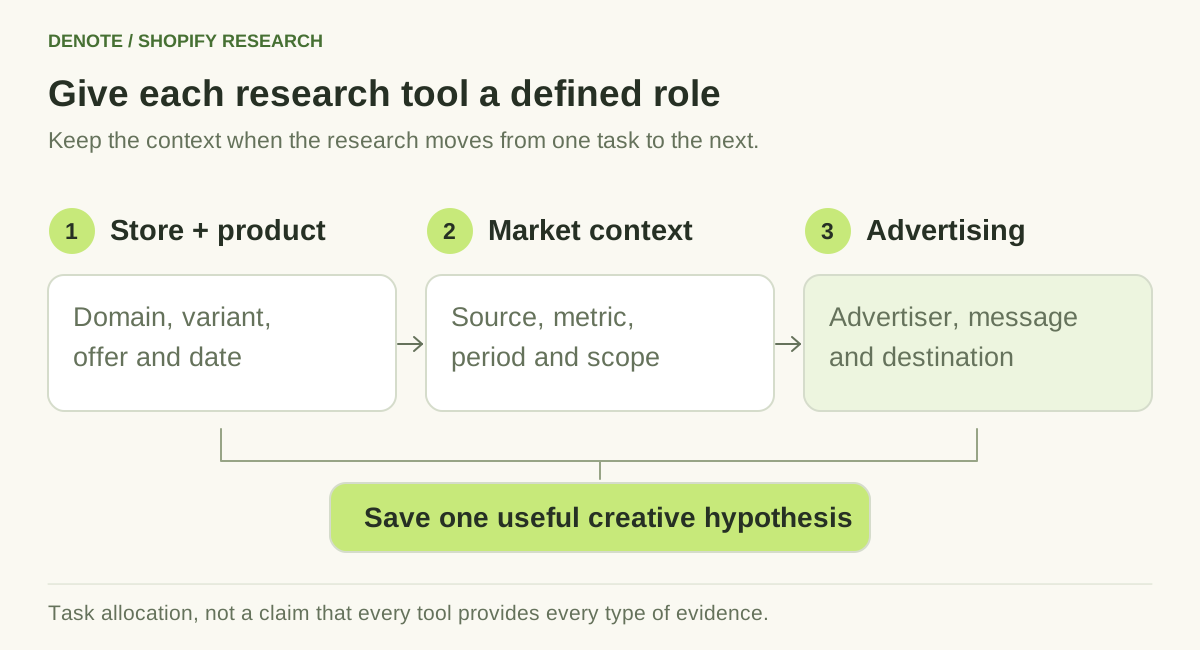
Give each tool a defined role and preserve the domain, date and source when moving between tasks.
4. Semrush: for search-led competitor research
Evaluate Semrush when organic search is the central part of your research. Search visibility, keywords, and ranking pages can help you understand what brings a competitor into the search results and where your content may answer an unmet question.
Example task: You want to see whether competing travel brands attract search interest around packing guides, product categories, or specific problems before planning your own content.
Check before choosing: Verify the selected country database, reporting date, and report type. Separate organic search estimates from broader traffic reports. Semrush documents different methods behind different traffic figures; they should not be treated as interchangeable measurements.
Boundary: Organic search visibility does not describe the whole acquisition mix. A store can be active in paid social or other channels without showing a comparable organic footprint. Search research is one part of Shopify competitor analysis, not a substitute for reviewing the offer and creative.
5. Meta Ad Library: for direct public ad lookup
Use Meta Ad Library when your immediate task is to find public ads associated with an advertiser on Meta. It is a useful starting point for checking a brand's visible messaging and following the available ad destinations.
Example task: Before a creative review, search for a known brand, confirm the advertiser, and collect a few ads that illustrate different product arguments.
Check before choosing: Confirm that you found the correct advertiser and selected the relevant region and filters. Record the observation date and destination because the public results you can access may change.
Boundary: It covers Meta's library rather than a complete cross-platform Shopify research workflow. Public creative availability does not tell you the advertiser's profitability. If you need a repeatable process for organizing references and returning to brands, evaluate how you will handle those steps alongside ad lookup.
Use the same sample to evaluate every tool
Choose three stores relevant to your market: one established store, one smaller store, and one with a brand or regional domain structure that needs careful matching. Ask each tool to support the same research task.
| Evaluation question | What to write down |
|---|---|
| Did it identify the right business? | Store domain, advertiser, and any ambiguity |
| Is the required data available? | Available fields and missing coverage |
| What does each number measure? | Metric definition, source, and scope |
| How current is it? | Observation date and reporting period |
| Can you revisit the research? | Saved items, notes, history, or your manual process |
| Does it answer the original question? | The decision you can now make |
| Does the plan fit the workload? | Current access limits and the tasks you actually need |
Do not score a tool higher simply because it displays more numbers. A clear source, a relevant store match, and a useful next action matter more than an unexplained estimate.
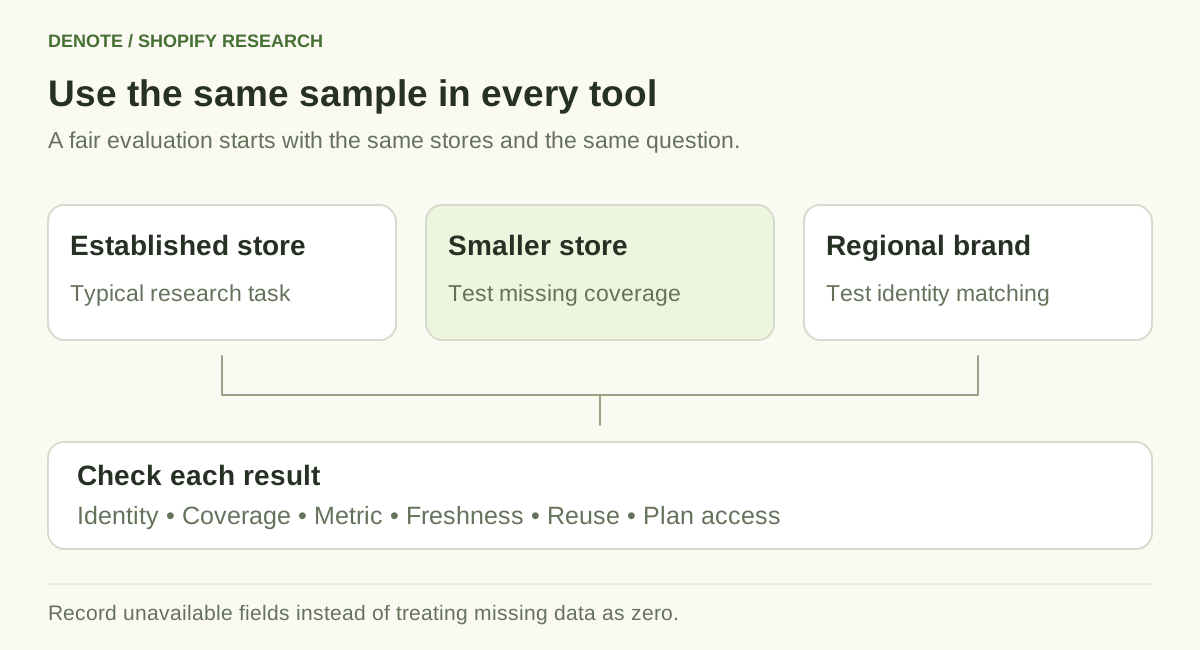
Use the same sample to compare tools; record missing coverage explicitly.
Avoid these switching mistakes
Expecting one tool to replace unrelated tasks. Store inspection, search analysis, traffic estimation, and creative organization are different jobs. Decide which gaps matter before switching.
Comparing mismatched traffic figures. Organic traffic and total visits are not the same measure. Two providers can also estimate different totals without either being a direct count of the store's analytics.
Treating visible ads as verified winners. Longevity and repeated creative themes can justify a closer look. They do not establish sales performance.
Losing the context around saved examples. Keep the domain, product, date, and reason you saved an ad. Otherwise, a research collection becomes difficult to use in a brief.
For repeated reviews, use the Shopify store change tracking workflow to keep observations dated and comparable.
Frequently asked questions
What is a free Trendtrack alternative?
Meta Ad Library is a free starting point for public Meta ad lookup. Public storefront research is another useful method. Neither replaces every part of a broader store, traffic, and brand research workflow. Other tools may offer limited access; check current terms.
Which alternative is useful for Shopify product research?
First decide whether you mean inspecting products, assessing market context, or studying how products are advertised. Koala Inspector focuses on storefront inspection, while Denote connects store context with advertising research. Native collection sorting can also help build an initial product shortlist.
Should I use more than one research tool?
Sometimes. A traffic source and an ad research workflow can answer different questions. Give each tool a defined role and avoid paying for overlapping functions you rarely use.
Can these tools show exact competitor revenue?
Public store and ad research does not provide access to private transactions. Any modeled revenue figure needs a disclosed methodology and should remain labeled as an estimate.
Where should I start if my priority is better creative?
Choose one relevant store, review one product offer, and collect ads that make different arguments about it. Use Denote to connect those references with the brand research behind your next brief.


