
If you've ever stared at your marketing budget wondering whether to put it into Facebook Ads or Google Ads, you're not alone. It's one of the most common questions business owners and marketers face today, and the honest answer is: it depends on what you're trying to achieve.
Both platforms are powerhouses. Together, Google and Meta command over 50% of the global digital advertising market, and for good reason. But they work in fundamentally different ways, serve different purposes in the customer journey, and suit different types of businesses.
This guide breaks down everything you need to know, from costs and targeting to ad formats and real use cases, so you can make a smarter decision for your business. If you want to go further, tools like Denote can help you track performance, manage campaigns, and make data-driven decisions across both platforms.
What Are Facebook Ads and Google Ads?
Before diving into the comparison, it helps to understand what each platform actually does and how they approach advertising differently.
How Facebook Ads Work
Facebook Ads is part of Meta's advertising ecosystem, allowing businesses to promote across Facebook, Instagram, Messenger, Reels, and the Audience Network. It's a discovery-based model , users aren't searching for your product. They're scrolling, watching videos, and chatting. Your ad appears in their feed, interrupting their attention with something relevant to their interests or lifestyle.
This makes Facebook Ads what marketers call a "demand creation" platform. You introduce people to products and brands they didn't know they needed yet.
How Google Ads Work
Google Ads is Google's pay-per-click (PPC) advertising platform, designed to serve ads on search results, YouTube, Shopping, and across millions of websites in the Google Display Network. It's intent-driven, meaning your ads appear when people are actively searching for products, services, or solutions related to your offer.
This is what makes Google a "demand capture" platform. The customer already wants something; Google just puts your business in front of them at the right moment.
Key Differences at a Glance
The core distinction is simple: Facebook targets who people are, while Google targets what people are looking for. One builds demand; the other captures it. Both are essential, and together, they cover the entire customer journey.
Facebook Ads vs Google Ads: Core Comparisons
Targeting Capabilities
Facebook's Audience-Based Targeting
Facebook's targeting is built around identity and behaviour. You can target new parents who like organic food, live in specific cities, and have household incomes over $75,000. Or create lookalike audiences based on your best customers.
This level of demographic and psychographic granularity is Facebook's biggest competitive advantage. However, it's worth noting that as of March 2025, Meta retired several detailed targeting exclusions and layered filters, pushing advertisers to use broader targeting and rely on creative and data signals instead of manual micro-targeting.
Google's Intent-Based Targeting
Google Ads focuses on keywords and context. You target searches like "running shoes for flat feet" or "small business accounting software." You can also layer in location, device type, and time of day.
Google's targeting is built around the moment of intent, the precise second someone types in a search query. This makes it particularly effective for capturing bottom-of-funnel buyers who are ready to act now.
Cost Comparison
Average CPC on Facebook Ads
Facebook traffic campaign CPCs decreased for 10 out of 21 industries, with an overall cost per click of only $0.70, a 6.67% decrease year-over-year. For lead generation campaigns, CPC sits at $1.92 for Lead Ads, still substantially lower than the average CPC of $5.26 on Google Ads.
Average CPC on Google Ads
In 2025, Facebook averaged $1.72 per click compared to Google's $5.26 per click. Costs vary significantly by industry, legal and finance sectors on Google can easily exceed $10–$50 per click in competitive markets.
Which Platform Offers Better ROI?
Lower CPC doesn't automatically mean better ROI. Google's high CPC isn't a bug, it's a feature. The higher cost reflects higher intent, which means better conversion rates when you target the right keywords.
On the cost-per-lead front, Facebook's average CPL is $27.66, compared to Google's average CPL of $70.11, making Facebook significantly more cost-efficient for lead generation volume. But Google leads often convert to sales faster due to higher purchase intent.
Ad Formats
Facebook Ads Formats
Facebook Ads are built for visual storytelling. You can include single images, videos, carousels, collections, and interactive formats that feel native to social feeds.
Video is particularly powerful on the platform. Vertical ads optimised for Stories and Reels can reduce cost-per-click by up to 40% and increase video completion rates by 35%. Additionally, 85% of Facebook videos are watched without sound, making captions essential for engagement.
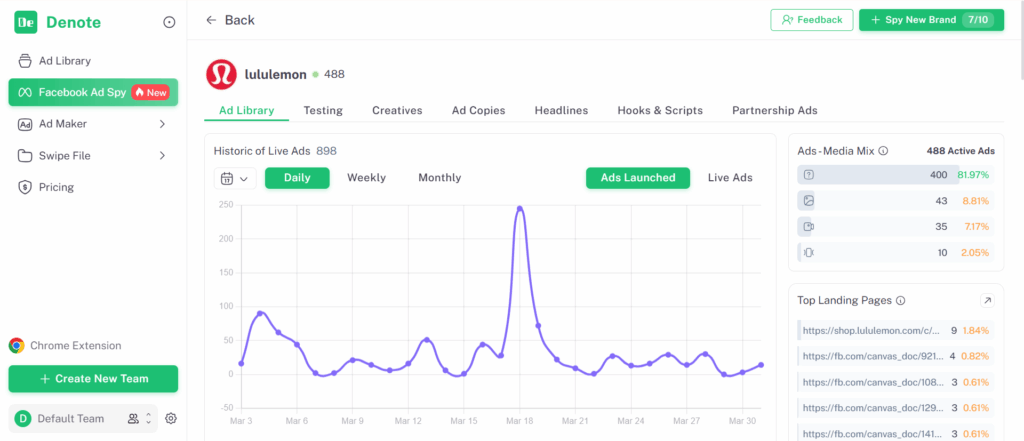
Before launching your creatives, it's worth researching what's already working in your niche. Using an ad spy tool lets you browse real competitor ads across Facebook and Google, so you can spot winning formats and angles before spending a single dollar on testing.
Google Ads Formats
Google offers a wider range of format types across its network: Search ads (text-based, appear in search results), Display ads (image banners across 2M+ websites), Shopping ads (product listings with images and prices), YouTube video ads, and Performance Max campaigns that blend all of the above.
AI Max for Search campaigns, launched in May 2025, is Google's newest suite of AI-powered targeting and creative enhancements. Advertisers who activate AI Max typically see 14% more conversions at similar CPA/ROAS.
Audience Reach & Demographics
Who Uses Facebook?
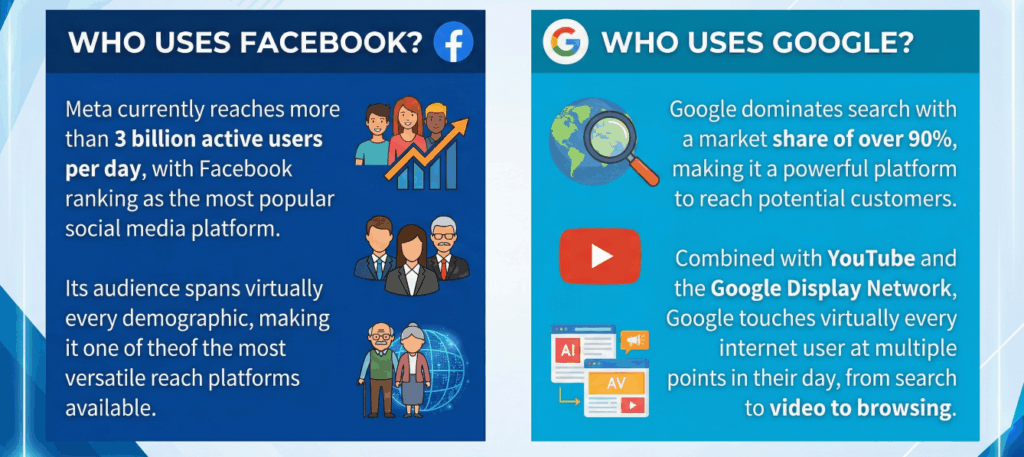
Meta currently reaches more than 3 billion active users per day, with Facebook ranking as the most popular social media platform. Its audience spans virtually every demographic, making it one of the most versatile reach platforms available.
Who Uses Google?
Google dominates search with a market share of over 90%, making it a powerful platform to reach potential customers. Combined with YouTube and the Google Display Network, Google touches virtually every internet user at multiple points in their day, from search to video to browsing.
Campaign Objectives & Use Cases
Best Use Cases for Facebook Ads
Facebook performs best when you want to build brand awareness with visual storytelling, reach new audiences who don't yet know they need your product, run retargeting campaigns to re-engage past visitors, promote e-commerce products through discovery-driven shopping, and generate leads at a lower cost per lead than search platforms.
Best Use Cases for Google Ads
Google excels when users are actively searching for your product or service, when your business relies on immediate purchase intent (e.g., emergency services, SaaS trials, local services), when you want to appear at the top of search results for high-value keywords, and when running Shopping campaigns for product-based e-commerce.
Which Platform Is Better for Your Business?
Best for Brand Awareness
Facebook wins here. Its visual formats, massive daily active user base, and interest-based targeting make it the go-to platform for getting your brand in front of new audiences at scale and at a relatively low CPM.
Best for Lead Generation
Despite rising advertising costs and economic challenges, Facebook Lead Ads maintain a cost advantage over Google Ads, with a CPL of $27.66 vs Google's $70.11. For volume-focused lead generation, Facebook delivers more leads per dollar. However, if lead quality and conversion speed matter more than volume, Google's intent-based traffic is harder to beat.
Best for E-commerce & Sales
Both platforms serve e-commerce well, but in different ways. Facebook delivers the lowest CPC at $0.45 for e-commerce, making it ideal for product discovery. Google's lower CPM works well for remarketing via the Display Network. The smartest e-commerce brands use Facebook for top-of-funnel discovery and Google to close the sale.
Best for Small Businesses
Facebook Ads are generally cheaper than Google, with average CPCs between $0.70–$1.92. You can start testing with as little as $5–$10 per day. This makes Facebook more accessible for small businesses with tight budgets. Google requires deeper pockets, especially in competitive industries, but can deliver fast returns when targeting is sharp.
Best for B2B Marketing
Google tends to perform better for B2B, where buyers actively search for solutions by name. Search ads targeting queries like "best CRM for law firms" or "project management software for agencies" reach decision-makers at the exact moment of research. Facebook can support B2B awareness campaigns, but the purchase cycle and conversion tracking are more complex.
Should You Use Facebook Ads and Google Ads Together?
Why a Combined Strategy Works
The most effective advertisers in 2025 aren't choosing one platform over the other, they're using both strategically. Businesses using both platforms strategically often report better results, because the two platforms complement each other across the full customer journey.
How to Build a Full-Funnel Strategy
Top of Funnel – Awareness (Facebook)
At the awareness stage, Facebook is your best tool. Use interest-based and lookalike audiences to introduce your brand to people who fit your ideal customer profile. Video ads, Reels, and carousel formats work especially well here for capturing attention and building familiarity.
Bottom of Funnel – Conversion (Google)
Once someone is aware of your brand or has shown interest, Google Search captures them when they're ready to act. Retargeting on the Google Display Network also allows you to re-engage Facebook visitors as they browse the web, closing the loop between the two platforms.
A real-world example: an e-commerce brand used Google Ads to target buyers searching "buy summer dresses," bringing in 30% of new visitors with solid conversions. They then retargeted those Google Ads visitors on Facebook who didn't complete a purchase, lifting their conversion rate by 20%. Together, they achieved a 45% sales boost and a 15% drop in cost per conversion.
How to Get Started
Setting Up Your First Facebook Ad Campaign
Start by creating a Meta Business Account and connecting your Facebook Page. Choose a campaign objective (Traffic, Leads, or Sales), define your audience using demographics, interests, or a lookalike audience, set your daily or lifetime budget, and select your ad format. For beginners, image or carousel ads in the Feed placement are the easiest starting point.
Setting Up Your First Google Ad Campaign
Create a Google Ads account and choose your campaign type, Search is the best starting point for most businesses. Build your keyword list around what your customers are searching for, write compelling ad copy with clear calls to action, and set your bid strategy. Smart Bidding (Target CPA or Target ROAS) is recommended for beginners who want Google's AI to optimise delivery.
Budget Recommendations for Beginners
For Google Ads, budget at least $500–$1,000 per month to gather enough data for optimisation. For Facebook Ads, $500–$1,500 per month is recommended for meaningful results, though you can start testing with as little as $5–$10 per day.
If you're running both, a common agency approach is to allocate about 57% of the ad budget to Google and 43% to Facebook. For sales-led goals, skew 60–75% toward Google Ads. For brand awareness, tilt 60–70% toward Facebook Ads.
One more tip: before committing budget to either platform, use an ad spy tool to study what your competitors are running. Seeing real live ads in your category can inform your creative direction, bidding strategy, and even which platform to prioritise first.
Final Verdict: Facebook Ads vs Google Ads
Quick Comparison Table
Our Recommendation
There's no universal winner. Facebook Ads is the smarter choice if you're building brand awareness, reaching new audiences visually, or generating leads at lower cost. Google Ads wins when you need to capture buyers who are actively searching and ready to convert.
For most growing businesses, the real answer is to use both. Start with one based on your primary goal, gather data, then layer in the second platform to cover more of the customer journey. The brands seeing the strongest returns in 2025 aren't choosing between Facebook and Google, they're building systems that use both together. Managing that dual-platform strategy is much easier with a tool like Denote, which centralises your campaign data and helps you optimise across channels in one place.
FAQs
Is Facebook Ads cheaper than Google Ads?
Yes, on a cost-per-click basis. Facebook's overall CPC is $0.70 for traffic campaigns, which is much lower than the average CPC of $5.26 in Google Ads. However, cheaper clicks don't always mean cheaper results, Google's higher-intent traffic often converts faster, which can make the overall cost of acquisition more comparable.
Which is better for small businesses?
Facebook Ads generally offers a lower barrier to entry and more flexible budgeting options, making it a popular starting point for small businesses. That said, if your customers are actively searching for your product or service, even a modest Google Ads budget can deliver strong returns.
Can I run both Facebook and Google Ads at the same time?
Absolutely, and for most businesses, running both is the recommended approach. They serve different stages of the customer journey and complement each other well. Use Facebook to build awareness and Google to capture intent.
Which platform has better targeting?
They're strong in different ways. Facebook offers deeper audience-based targeting using demographics, interests, behaviours, and lookalike audiences. Google offers more precise intent-based targeting through keywords and search queries. The best targeting approach depends entirely on your product and who your customer is.