
Meta has rolled out its most extensive advertising policy revision cycle to date in 2026, over 47 documented updates across Facebook and Instagram. Whether you run ecommerce campaigns, promote financial services, or work with influencers, these changes will directly affect how your ads are reviewed, approved, and delivered. With policy updates rolling out at this pace, having reliable ad intelligence is more important than ever, platforms like Denote help advertisers track performance data and market signals across Meta campaigns so you can make faster, more informed decisions when the rules change. This guide covers every major update you need to know, and what to do about it.
What's New in Meta Ads Policy in 2026
Key Updates at a Glance
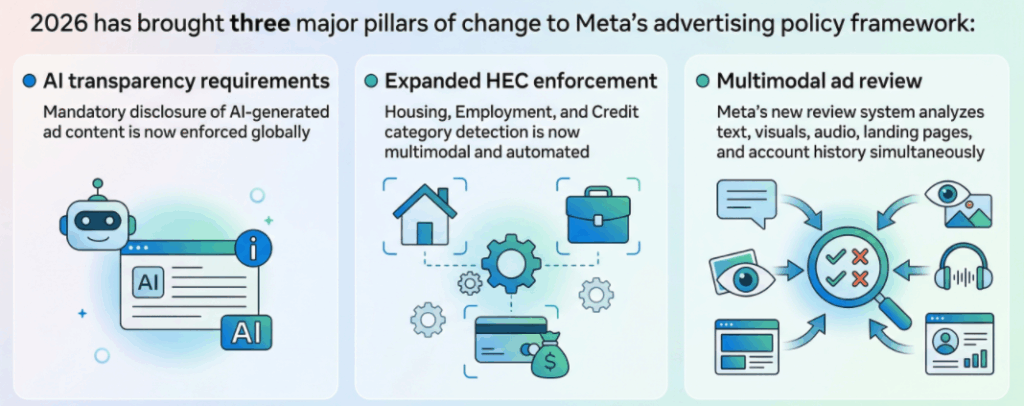
2026 has brought three major pillars of change to Meta's advertising policy framework:
- AI transparency requirements: Mandatory disclosure of AI-generated ad content is now enforced globally
- Expanded HEC enforcement: Housing, Employment, and Credit category detection is now multimodal and automated
- Multimodal ad review: Meta's new review system analyzes text, visuals, audio, landing pages, and account history simultaneously
If your compliance workflow hasn't been updated since 2024, you are likely to see meaningfully higher rejection rates and account health degradation in 2026.
Why Meta Keeps Updating Its Ad Policies
Meta's policy updates are driven by three forces converging at once: tightening global regulation (the EU's AI Act, the Digital Markets Act, and MiCA for crypto), an explosion in AI-generated ad creative, and growing regulatory scrutiny around special ad categories like housing, credit, and health. Meta is also responding to a surge in user complaints about misleading health and financial ads in H2 2025, complaints that attracted attention from the FTC and EU regulators alike.
How These Changes Differ From Previous Years
In previous years, Meta's review system was largely reactive, ads were flagged after complaints or human review. In 2026, Meta has transitioned to proactive enforcement via its Multimodal Ad Review System (MARS), which scans every ad across five data layers before the first impression is served. The era of "launch and see what happens" is over.
Changes to Special Ad Categories
Meta's Special Ad Categories, covering Housing, Employment, and Credit (HEC) have been significantly expanded and are now enforced through automated visual and semantic detection.
Housing, Employment, and Credit Ads
The most impactful change for HEC advertisers is the shift from keyword-based detection to multimodal detection. Previously, advertisers could sometimes avoid HEC classification by using indirect language. In 2026, Meta's classifiers analyze ad images for real estate imagery (floor plans, building exteriors, "For Sale" signs), employment imagery (office environments, hiring content), and credit-related visuals (credit card mockups, loan calculators). If any visual element suggests HEC content, the restrictions are automatically applied, even if the advertiser did not manually select the Special Ad Category. Attempting to bypass this is flagged as an "Evasion" violation and directly damages account health.
Location targeting under HEC is also stricter: the 15km minimum radius is now enforced alongside a prohibition on city-level audience exclusions.
What Targeting Options Are Now Limited
Under 2026 HEC rules, the following targeting restrictions are now automatically enforced:
- Age targeting is limited to 18–65+, auto-applied on detection
- Custom lookalike audiences are disabled; "Special Ad Audiences" have been deprecated
- City-level neighborhood exclusions are prohibited
- BNPL (Buy Now Pay Later) products are now explicitly classified under the Credit category, meaning ecommerce brands promoting BNPL checkout options must now use HEC ad settings
Health and Wellness Restrictions
Health and wellness remains the most heavily regulated ad category on Meta. Key 2026 changes include:
- Before/after imagery ban extended to implied transformations: Showing a product next to an image of a healthy person is now treated the same as an explicit before/after image. Testimonial videos where a customer describes their transformation while visibly healthy can trigger this classifier.
- Supplement ad disclaimer: All health supplement ads must now include the disclaimer "This product is not intended to diagnose, treat, cure, or prevent any disease" directly in the ad copy, not just on the landing page.
- Weight management sub-category: Weight loss advertising must now be classified under a dedicated "Weight Management" sub-category with additional targeting restrictions. Ads cannot reference specific weight loss amounts or time-bound claims ("Lose 10 lbs in 30 days").
- Blood sugar and diabetes claims: Ads targeting these conditions face pre-approval review requirements in EU and APAC markets. Testimonials with specific numerical health outcomes (e.g., "My A1C dropped from 8.2 to 6.4") are categorically rejected.
Financial and Insurance Products
Meta's financial advertising policy in 2026 reflects increased coordination with financial regulators globally. Advertiser verification is now mandatory in 38 countries, up from 12 in 2024. Each market requires country-specific documentation: FCA registration for the UK, BaFin authorization for Germany, SEC/FINRA registration for the US, and equivalent credentials elsewhere.
Any ad referencing specific interest rates, investment returns, or yield percentages must now include Meta's standardized risk warning templates. Ads using non-standard disclaimer text are automatically rejected.
What Targeting Options Are Now Limited
Financial service advertisers should note the following audience restrictions now in place:
- Crypto ads are prohibited from targeting users under 25 (up from 18)
- Financial product ads must not imply guaranteed returns or risk-free investing
- Lookalike audiences built from financial product converters require updated data consent documentation
Content and Creative Policy Updates
New Rules on AI-Generated Content
Following the EU AI Act's enforcement timeline, Meta has made AI content disclosure mandatory for all advertising globally. Any ad creative where AI tools were used to generate or substantially modify visual or audio content must carry an "AI-generated" label in Ads Manager at submission. This includes AI-generated product imagery, background replacement, synthetic voiceovers, face or body modification beyond standard filters, and AI-created video.
Meta has also deployed its own AI content detection models that check for C2PA metadata from tools like DALL-E, Midjourney, and Stable Diffusion, and perform visual analysis for synthetic artifacts. If Meta detects undisclosed AI content, the ad is rejected and the account receives a policy strike. In 2026, undisclosed AI content is already the third largest rejection category, accounting for an estimated 14% of all rejections.
Note: Meta's Advantage AND Creative system, which automatically generates ad variations, handles AI labeling internally and is exempt from manual disclosure requirements.
Prohibited Language and Claims
Meta's March 2026 enforcement update introduced semantic intent detection, meaning the system evaluates the implied meaning of ad copy rather than just literal phrasing. Practical implications include:
- "See results in 7 days" paired with a before/after image is treated as a misleading transformation claim even without the word "guarantee"
- Indirect second-person framing like "For people managing diabetes" is now flagged at similar rates to direct "you" language
- Phrases implying a product will "lower," "regulate," or "stabilize" blood sugar require a qualifying disclaimer and cannot appear in headlines
Image and Video Creative Restrictions
The key change in 2026 is the automated detection of implied before/after transformations, ads no longer need to use explicit "before" and "after" labels to be flagged. Meta's image analysis models detect visual patterns characteristic of transformation sequences, including changes in lighting, posture, body composition framing, or facial expression.
For video ads, audio is now reviewed using speech-to-text transcription and sentiment analysis. Claims made verbally are held to the same standards as written copy.
What "Before and After" Content Is No Longer Allowed
The following creative formats are now rejected under Meta's 2026 policies:
- Dated before/after photos without labels (implied timeline claim via image sequencing)
- A product shown next to a visibly transformed person (implied outcome)
- Testimonial video where a customer describes their journey while appearing healthy (implied transformation)
- Any image sequence that shows lighting, posture, or body composition changes, even if unlabeled
Privacy and Data Handling Requirements
How Audience-Building Tools Have Changed
Meta has moved away from traditional lookalike audiences as a targeting mechanism. In 2026, lookalike audiences are in the process of being phased out as a default option, replaced by predictive models based on machine learning and aggregated behavioral data. This shift is designed to reduce reliance on personal data while maintaining targeting performance. For advertisers, it means segmentation strategy must increasingly rely on engaging creative and organically activated audiences rather than data-matching tools.
For HEC categories, "Special Ad Audiences" have been deprecated entirely. Advertisers in these categories must rely on broad targeting guided by creative relevance.
Consent and Transparency Obligations
Meta's updated privacy policy, which took effect in January 2026, now allows the platform to use interactions with Meta AI (across Facebook, Instagram, and WhatsApp) to personalize ad targeting. Users who interact with Meta AI about a topic, such as hiking or home buying, may see relevant ads based on that interaction. Meta has stated that interactions about sensitive topics such as political views, sexual orientation, or trade union membership will not be used for ad targeting.
In the EU, Meta is now required under the Digital Markets Act to present users with a choice between full personalized advertising and a more limited personalized advertising option. This rollout began in January 2026 following a non-compliance finding by the European Commission.
Cross-Border Data Transfer Rules
EU-targeted campaigns must now comply with GDPR Article 46 transfer mechanisms and MiCA Article 29 disclosure requirements for crypto products, enforced at the ad review layer. Advertisers running campaigns across multiple regions are advised to audit their data transfer and consent documentation by market.
How These Policy Changes Impact Your Campaign
Ad Approval Rates: What to Expect
The most common rejection reasons in 2026 are:
Advertisers in health, wellness, and beauty verticals saw rejection rates spike by an estimated 34% in Q1 2026 compared to Q4 2025, following the March enforcement update.
Targeting Limitations and Reach Impact
The deprecation of Special Ad Audiences and the phaseout of detailed lookalike targeting for HEC categories will reduce granular audience control for advertisers in regulated industries. For non-HEC advertisers, the shift to AI-driven targeting through Advantage+ means detailed targeting selections are increasingly treated as suggestions rather than hard parameters, Meta's systems will optimize delivery based on campaign signals, potentially broadening or narrowing reach beyond the selected audience.
Tools like Denote can help marketers track campaign intelligence data and monitor competitor ad strategies as targeting becomes less deterministic and more AI-driven.
Budget and Delivery Disruptions
Ad rejections and policy violations do not just delay a single ad, they degrade your Account Health Score, which now directly affects the delivery and cost of all active campaigns. Accounts scoring below 50 face longer review times and higher rejection rates across the board. Accounts scoring below 25 are placed on "Restricted Delivery," where impressions are severely limited until the score recovers (a process that takes up to 90 days of clean operation).
Policy violations that halt campaigns mid-flight can result in significant wasted spend and lost momentum, particularly costly for time-sensitive promotions.
Account Health Risks if You Don't Comply
Meta's Account Health Score is now publicly visible in Ads Manager on a 0–100 scale. It reflects your violation history, rejection rate, and compliance track record. Risks of non-compliance include:
- Increased review times for all submitted ads
- Higher CPMs as restricted delivery limits auction competitiveness
- Account disablement in cases of repeated or severe violations
- Loss of access to campaign history and conversion data if account is disabled
How to Keep Your Campaigns Running After the Update
Pre-Launch Compliance Checklist
Before submitting any ad in 2026, verify the following:
- Ad copy does not use personal attribute framing ("Do you have X condition?", "For people managing Y")
- Health claims include required disclaimers directly in the ad copy
- AI-generated creative is labeled in Ads Manager
- Landing page content matches ad claims. Meta's review system now checks both as a single compliance unit
- Correct Special Ad Category is selected if content touches housing, employment, credit, health (weight management), or financial products
- Creator/influencer content is running through Partnership Ads format, not as simulated organic content
- Whitelisting consent is verified within the last 90 days for any creator whose handle is being used
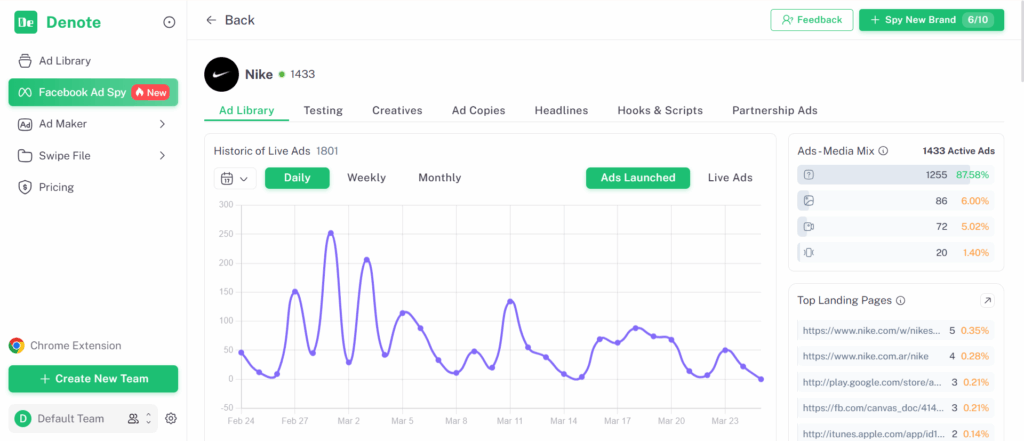
For competitive intelligence and tracking how policies are affecting your ad landscape, tools like Denote's Ad Spy provide visibility into what competitor ads are running and how they are structured, useful context when auditing your own creative approach.
How to Handle a Rejected Ad
If your ad is rejected:
- Review the rejection notice in Ads Manager to identify which policy category was flagged
- Check all five compliance layers: ad copy, creative, audio (for video), landing page, and Special Ad Category selection
- Make targeted changes to address the flagged element, avoid making broad changes that could trigger re-review on other dimensions
- Resubmit the corrected ad
If you believe the rejection is a false positive, do not simply duplicate and resubmit the original ad. This is flagged as an evasion attempt and worsens your Account Health Score.
How to Request a Review from Meta
Meta's 2026 appeal system follows a three-tier structure:
- Tier 1: Automated re-review triggered by the "Request Review" button in Ads Manager. Resolves approximately 35% of false positives within 24 hours.
- Tier 2: Human review by Meta's policy team, available if Tier 1 is denied. Typical resolution: 3–5 business days.
- Tier 3: Escalated review by Meta's Policy Advisory Board, for complex cases involving novel policy interpretation. Resolution: 10–15 business days.
Step-by-Step: Using Business Support Home
- Go to Business Support Home
- Navigate to the account or catalog containing the rejected ad
- Select the specific ad, ad set, or campaign you want reviewed
- Click "Request Review" and follow the prompts to submit
For account-level restrictions, follow the same steps but select "Account Status Overview" from the left menu first, then choose the restricted account before requesting review.
FAQs on Meta Ads Policy Update 2026
What happens if my ad violates the new policy?
A policy violation results in ad rejection and a negative mark on your Account Health Score. Repeated violations lead to higher rejection rates across all campaigns, restricted ad delivery, and, in severe or repeat cases, account disablement. Meta's 2026 appeal system offers structured recovery pathways including compliance training modules and re-certification for disabled accounts.
Do the 2026 updates affect all ad formats?
Yes. The Multimodal Ad Review System (MARS) reviews all ad formats, static images, video, carousel, and lead ads, across the same five compliance layers. Video ads face additional audio review, meaning verbal claims in voiceover or creator speech are held to the same standards as written copy. Lead ad question formats also require specific permissions depending on the type of information requested.
How often does Meta update its advertising policies?
Meta publishes policy updates in the Advertiser Help Center and the Meta Business Blog on a rolling basis. In 2026, the platform has already implemented 47 documented policy updates in the first quarter alone. Advertisers working in regulated industries, health, finance, housing, and crypto, should treat monthly policy reviews as a standard operational practice rather than an occasional task. Staying current is not optional if you want predictable ad delivery.
Keeping a close eye on the competitive ad landscape can also help you understand how the industry is adapting to these changes. Denote tracks active ad strategies across Meta and other platforms, giving you a broader view of how compliant advertisers are structuring their campaigns in 2026.


