
If your Facebook or Instagram ads started behaving strangely sometime in late 2024 or early 2025, costs creeping up, top-performing creatives suddenly going cold, targeting that used to work falling flat, you weren't imagining it.
We weren't either.
Our team at Denote runs paid social for a range of e-commerce clients, and the shift hit us gradually, then all at once. We'd already written about the early Andromeda rollout back in November 2025. But the system has kept evolving. By early 2026, with Graph API v25.0 live, Advantage+ now set as the default for new campaigns, and Meta officially treating detailed targeting inputs as suggestions rather than hard constraints, the playbook has changed again.
This isn't a recap of what Andromeda is. This is what's different in 2026, and how we've adapted our strategy to stay ahead.
Why We're Writing This (And Who This Is For)
Our Team Ran Facebook Ads Through the Andromeda Transition: Here's What We Saw
We started noticing the shift in Q1 2025. Campaigns that had delivered reliable ROAS for months began swinging unpredictably. CPMs climbed. A few of our sharpest-targeted ad sets, the ones we'd spent months refining, started hemorrhaging spend without results.
We tried the obvious fixes: refreshed creatives, tweaked audiences, checked pixel health. Some of those helped. But the underlying dynamic had changed. Andromeda had fundamentally rewired how Meta's delivery engine worked, and we were still running a 2024 playbook.
Over the following months, we rebuilt our approach from scratch, testing structures, creative volumes, refresh cadences, and signal strategies. By late 2025 and into 2026, we had enough data across enough accounts to see what was actually working.
That's what this article is.
Who Should Read This
This guide is for performance marketers, e-commerce teams, and brand advertisers who are actively running Meta campaigns and want a clear picture of what's changed in 2026, not a generic overview, but the specific shifts that affect how you structure, create, and optimize campaigns today.
If you're brand new to Facebook ads, this probably isn't your starting point. If you've been running ads for at least six months and you're trying to make sense of why results feel different, you're in the right place.
What Is the Meta Andromeda Update, Really?
The Old System vs. Andromeda: What Actually Changed Under the Hood
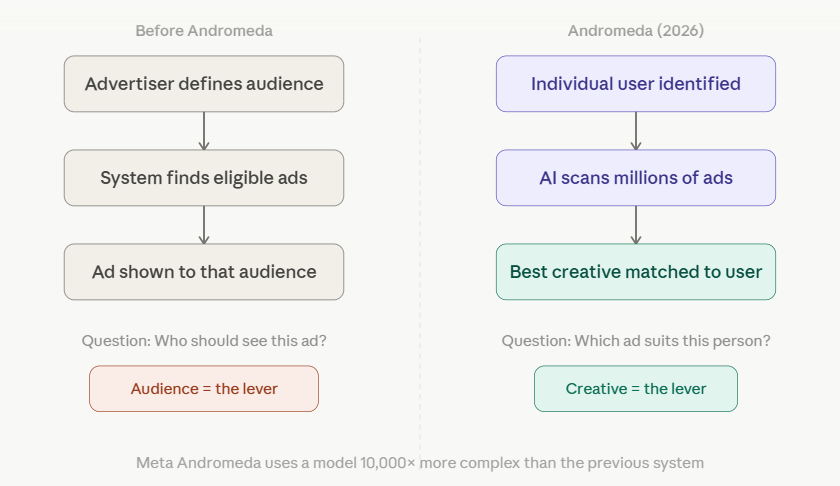
The previous Meta ad delivery system worked in a fairly linear way: you defined an audience, Meta looked at the pool of ads eligible for that audience, and it selected which ones to show based on targeting inputs and bid signals. Your audience definition was the primary driver of who saw your ads.
Andromeda flipped that logic.
Instead of starting with the audience you built and working outward, Andromeda starts with the individual user and works backward. It evaluates that person's behavioral signals, what they've clicked, watched, bought, scrolled past, and then determines which ad from the available pool is most likely to get a response from them.
In technical terms, it's a retrieval engine. It takes Meta's pool of tens of millions of active ads, narrows that to a few thousand candidates relevant to a specific user, and does this using a model that Meta's own engineering team described as 10,000 times more complex than what came before. The NVIDIA Grace Hopper Superchip powers the infrastructure behind this.
The Question Meta Is Now Asking: "Which Ad Should This Person See?"
The philosophical shift is worth naming clearly, because it changes everything downstream.
Before: "Who should see this ad?" After: "Which ad should this person see?"
That inversion moves the primary signal from your audience settings to your creative content. Andromeda reads your ads, visuals, copy, format, audio, and uses those signals to find users most likely to respond. The creative is now doing the targeting work.
The 10,000x Model: What That Number Actually Means for Your Campaigns
Meta's 10,000x model complexity increase isn't marketing language. It's the actual scale of what changed in how Andromeda processes ad candidates.
The old retrieval system could evaluate a limited set of ads per impression opportunity, relying heavily on rule-based heuristics and advertiser-defined inputs. That system buckled when Advantage+ Creative and generative AI tools caused an explosion in the number of ad variations being uploaded, the platform was suddenly processing hundreds of variations per advertiser where it once processed five or ten.
Andromeda was built to handle that scale. It can now evaluate thousands of creative variants in milliseconds, using deep neural networks to match the right ad to the right user in real time.
Why Andromeda Was Built: The Creative Explosion Problem
This is a detail most coverage misses: Andromeda wasn't just built to improve targeting, it was built because the old system couldn't cope with the volume of creative variations that Advantage+ and AI generation tools were producing. By the time Andromeda rolled out globally in October 2025, Meta was processing over 15 million new ad creatives per month. The legacy infrastructure had no path to handle that at scale.
What's New in 2026: The Changes That Matter Right Now
This is where we diverge from our November 2025 piece, and from most Andromeda coverage that's still recycling the same October 2025 talking points.
Graph API v25.0: What Launched on February 18, 2026
On February 18, 2026, Meta launched Graph API v25.0. For most advertisers, this won't appear anywhere in their Ads Manager. But the changes have direct implications for how campaigns are built and tracked.
The key updates:
Advantage+ Shopping Campaigns (ASC) and Advantage+ App Campaign (AAC) APIs are deprecated. If you or your tools were creating these campaign types via the Marketing API, migration to the unified Advantage+ campaign API is now required. The deprecation extends to all MAPI versions by May 19, 2026.
The smart_promotion_type field has been removed for campaign creation. Campaign creation is now streamlined toward the Advantage+ default. If you use third-party ad management tools, check whether they've updated for this change, older tools may throw errors.
Enhanced async error reporting for the Ads Insights API now returns detailed error codes and messages, making it significantly easier to debug reporting failures in external dashboards.
New attribution window limitations and shorter data retention periods took effect starting January 2026. If your ROAS reporting looks different from late 2025, this is part of why.
Advantage+ Is Now the Default: What That Actually Changes
As of early 2026, Advantage+ campaigns are the default setup for Sales, Leads, and App Promotion objectives. This isn't just a UI preference, it signals Meta's long-term direction. The platform is actively pushing advertisers toward automation-first structures.
For teams that have resisted Advantage+, this creates a decision point. Opting out is still possible, but you're now swimming against the current of how the platform is designed to work.
Detailed Targeting Is Now a Suggestion, Not a Constraint
This is one of the most significant practical changes of early 2026, and it's been underreported.
Meta's February 2026 API update formalized what had been quietly rolling out in the UI: detailed targeting inputs are now treated as suggestions rather than hard constraints. Your interest and demographic selections are advisory, Andromeda can and will reach users outside those parameters when it predicts better performance.
For advertisers who've spent years building carefully segmented audiences, this requires a real mindset shift. You're no longer drawing a fence around who sees your ad. You're providing signals that inform where Andromeda starts looking.
New Creative Intelligence Metrics in Ads Manager
Meta has begun rolling out three new creative-level metrics in Ads Manager that didn't exist in 2025:
Creative Fatigue Score: A direct signal that your ad is losing effectiveness. Until you're comfortable interpreting fatigue scores, treat rising CPMs as your primary red flag, they're the same underlying signal in a more familiar form.
Creative Similarity Score: If this is high, meaning your creative library lacks genuine diversity, Andromeda will penalize your account with higher CPMs. The algorithm interprets repetitive creative as fatiguing, even if the ads look slightly different to a human eye. Two product images with different backgrounds register as similar. One testimonial ad plus one pain-point ad plus one founder story register as genuinely different.
Top Creative Themes: Shows which emotional and messaging angles are actually resonating, humor, social proof, nostalgia, urgency. Use this to inform what concepts to develop next, not to over-optimize a single angle.
What Andromeda Broke: And Why Your Old Playbook Failed
We Tried the Old Way First: And It Cost Us 3 Weeks
When Andromeda hit our accounts, our first instinct was to do what had always worked: tighten the audience, refresh the copy, check the pixel. We spent about three weeks in diagnostic mode before we accepted that the underlying mechanics had changed.
The specific patterns we saw: narrow ad sets starved of impressions, top-performing creatives from Q4 2024 going cold within days of relaunch, and CPMs spiking on campaigns we hadn't touched. None of that was a targeting problem. It was a signal problem, we weren't giving Andromeda enough creative diversity to work with.
The 4 Strategies That No Longer Work
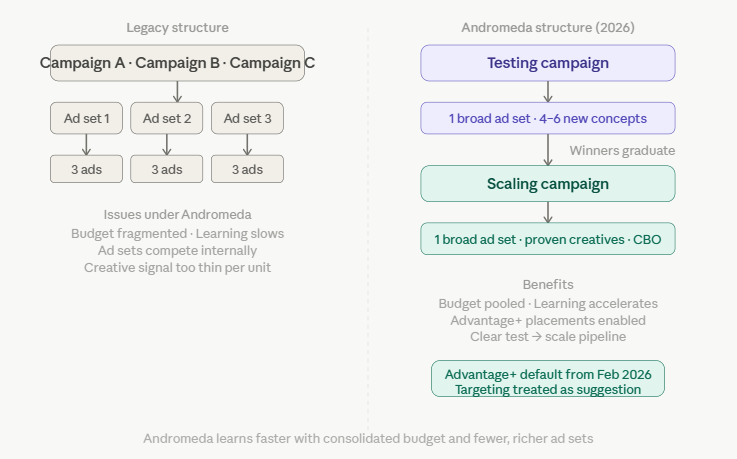
1. Narrow audience segmentation as a performance lever. Splitting campaigns into dozens of tightly defined interest buckets now fragments your budget and slows learning. Andromeda performs best with broad audiences and consolidated data.
2. Lookalike audiences as hard delivery boundaries. Lookalikes still have value, but their role has changed. They now function as signal seeds, they help Andromeda understand the profile of your ideal customer, but the system will expand beyond those boundaries when it identifies better opportunities.
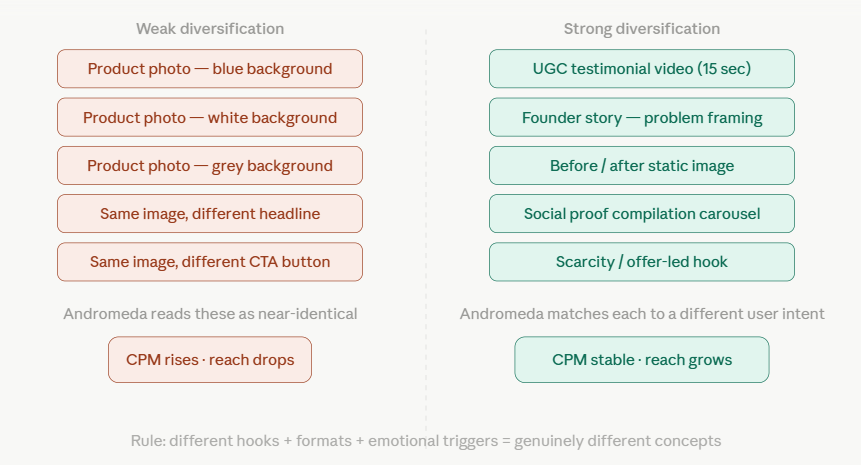
3. Minor creative variations as "testing." Two images of the same product at different angles are not meaningfully different to Andromeda. The system's visual recognition models may classify them as near-identical, and you'll pay for the lack of diversity through reduced delivery and higher CPMs.
4. Complex multi-campaign structures. Running ten campaigns with fifteen ad sets each fragments your budget, creates internal competition, and prevents any single unit from accumulating the data it needs to learn. Andromeda learns faster when it has more signal in fewer places.
Why "Just Upload More Creatives" Isn't the Answer Either
One of the most persistent misconceptions since Andromeda's rollout is that more creative is always better. It isn't.
As AdExchanger's VP Biddable Monica Shukla noted in January 2026, when creative supply dramatically outweighs available budget, learning slows and delivery fragments. A smaller account uploading 25 creatives with a $500/month budget isn't giving Andromeda more to work with, it's spreading signal so thin that nothing gets traction.
The right number of creatives is a function of your budget and conversion volume, not an absolute number.
How We Tested and Rebuilt Our Creative Strategy for Andromeda
Our Testing Criteria: What We Measured and Why
When we rebuilt, we focused on four metrics: ROAS trend over four-week windows (not day-to-day), CPM as an early warning signal for creative fatigue, creative-level CTR as a proxy for hook quality, and conversion rate by creative type to understand which formats drove actual outcomes.
We deliberately avoided optimizing for click volume or impression share, both of which can look healthy while underlying economics deteriorate.
Round 1: Broad Targeting + 5 Creative Variants (Failed)
Our first rebuild attempt used broad targeting (correct) but only five creative variants per campaign. The variants were also too similar, three product lifestyle images and two promotional graphics with different headline copy.
Results after two weeks: CPM increased, delivery concentrated on one or two creatives, and ROAS didn't improve. Andromeda didn't have enough genuinely different signals to match ads to different user intents.
Round 2: 12 Genuinely Different Concepts Across 3 Formats (Worked)
The second attempt used the same broad targeting structure but with 12 creatives representing genuinely distinct concepts: a UGC testimonial clip, a founder-led explainer, a before/after static, a problem-framing carousel, a social proof compilation, an offer-led video, and several hooks targeting different pain points and emotional triggers.
Formats included short-form vertical video (under 15 seconds), static images, and a carousel. Each ad had completely different copy, different imagery, and a different call to action.
Results after three weeks: CPM stabilized, delivery spread more evenly across creatives, ROAS improved meaningfully, and we identified two clear winners to scale.
The Difference Between "Variations" and "Concepts": Why It Matters to Andromeda
A variation is the same idea in a slightly different wrapper. A concept is a different idea entirely. Andromeda can tell the difference, or at least, it behaves as if it can.
Two product images with different backgrounds = weak diversification. One testimonial + one curiosity hook + one pain point + one founder story = real diversification.
The system needs options that represent different reasons a person might respond. If all your ads are saying the same thing in slightly different ways, Andromeda has nothing new to test.
What a "Creative-First" Campaign Structure Looks Like in Practice
The structure we've settled on for most accounts in 2026:
- 1 testing campaign: new concepts, new hooks, experimental formats. This is where we introduce 4–6 new creatives at a time.
- 1 scaling campaign: proven winners from the testing campaign, pushed with higher budget. Broad audience, Advantage+ placements enabled, CBO.
- Minimal ad sets per campaign: typically one broad ad set per campaign with all creatives inside.
This approach gives Andromeda consolidated data to learn from, reduces internal competition, and creates a clear pipeline from creative testing to scaling.
The Meta Andromeda Creative Strategy That Actually Works in 2026
How Many Creatives Do You Actually Need? (With Numbers)
The honest answer: it depends on your budget and conversion volume, not a fixed number.
A rough framework based on our account data:
- Under $1,000/month: 6–8 genuinely different concepts. Prioritize quality over quantity. Focus on your 2–3 highest-conviction ideas and test them properly before adding more.
- $1,000–$5,000/month: 10–15 concepts across at least 2 formats. Maintain a rotation so no single concept runs longer than 3–4 weeks without a refresh or replacement.
- $5,000+/month: 15–20+ concepts. You have the budget to support deeper learning across more variants. Use the scaling/testing campaign split described above.
The floor for Andromeda to learn meaningfully is approximately 50 conversions per week per campaign. If you're below that threshold, creative volume matters less than conversion volume, consider optimizing for a higher-funnel event to accelerate learning.
The Creative Refresh Cycle: Why Every 2–4 Weeks Is Now Non-Negotiable
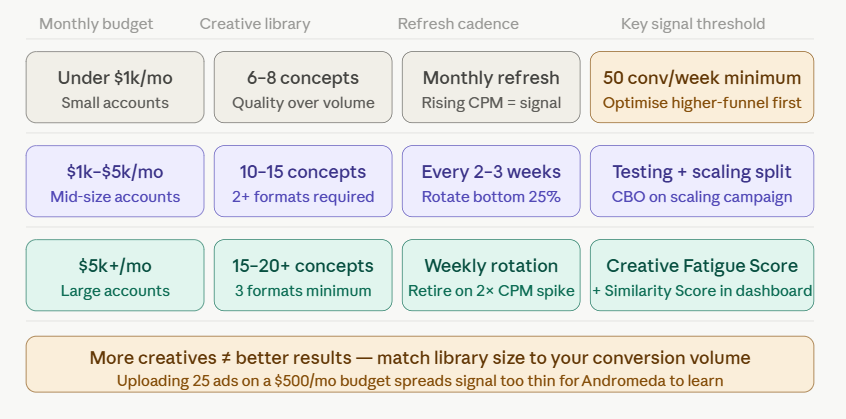
Under Andromeda, creative fatigue happens faster than it did under the old system. Even top-performing ads typically plateau within 2–4 weeks. The new Creative Fatigue Score in Ads Manager makes this visible; rising CPMs are the older, familiar version of the same signal.
The practical implication: you need a production cadence, not just a launch cadence. Creative strategy is now an ongoing operational function, not a quarterly project.
A workable rhythm: rotate the bottom 20–30% of creatives weekly, introduce 2–4 new concepts per testing cycle, and retire anything that shows two consecutive weeks of declining CTR or rising CPM.
Tools like Denote Ad Maker can help you maintain that cadence without burning out your team.
Format Diversity: Reels, Stories, Feed, and Why You Need All Three
Andromeda allocates delivery across placements based on predicted per-user response. Restricting to one or two placements limits the system's ability to find cost-effective opportunities across the full user base.
The practical data: for most accounts, 60–80% of impressions will naturally serve on Instagram anyway when Advantage+ placements is enabled. Forcing manual placement selection typically costs efficiency without improving targeting quality.
Short-form vertical video under 15 seconds, in a UGC-style production, is currently outperforming static images in many accounts, but static images still drive 60–70% of conversions on Meta according to Social Media Examiner's analysis. The answer isn't to pick one, it's to maintain both and let Andromeda allocate.
Early Video Hook Retention as a Performance Signal (1–3 sec Rule)
For video creatives, the first 1–3 seconds of retention is the single most reliable proxy for whether the algorithm will distribute the ad broadly. A hook that fails to retain viewers through the first three seconds signals low engagement potential; Andromeda will reduce delivery accordingly.
Test your hooks in isolation before committing to full creative production. A strong hook attached to an average body will outperform a weak hook attached to a great message.
Lookalike Audiences Are Not Dead: They're Just Different Now
Lookalikes haven't disappeared from the Meta playbook, but their function has changed fundamentally.
Pre-Andromeda, a Lookalike was a hard boundary: show this ad to people who look like my best customers, and only them. Post-Andromeda, a Lookalike is a signal seed: here's the profile of my best customers, use this to inform where you start, but optimize from there.
The practical implication is that you should still build Lookalikes from your highest-quality customer data (purchasers, high-LTV customers, repeat buyers), but you should use them alongside broad targeting rather than as a replacement for it. Andromeda will use the Lookalike signal as input and then expand based on what it learns from your creative performance.
Side-by-Side: Before Andromeda vs. After Andromeda in 2026
Campaign Structure Comparison Table
What Metrics to Watch Now (And Which Ones to Stop Obsessing Over)
Stop watching: Individual ad set reach, interest-based audience delivery breakdowns, CPC in isolation.
Start watching:
- ROAS at campaign level, tracked over 4-week windows rather than day-to-day
- Creative Fatigue Score and Creative Similarity Score (new in 2026 Ads Manager)
- CPM trend: rising CPM is your primary signal that creative is stale or too similar
- 1–3 second video retention rate: leading indicator of hook quality
- Add-to-cart rate: leading indicator of landing page and offer alignment
- MER (Marketing Efficiency Ratio): top-down measure of total ad spend efficiency across the account
Who This Strategy Is NOT For
If You Have a Tiny Budget (Under $500/Month), Read This First
Andromeda learns from conversion data. It needs at least 50 conversions per week per campaign to optimize meaningfully. On a $500/month budget, you may only be generating 10–15 conversions per month, not nearly enough signal for the system to learn.
If you're in this situation: don't try to run a complex creative library. Focus your budget on one tight campaign with your 3–4 best concepts. Optimize for a higher-funnel event like Add to Cart or Lead Form to generate enough conversion volume for the algorithm to learn. Expand creative volume as budget scales.
If You're in a Highly Regulated Industry (Finance, Healthcare)
Andromeda's creative-diversity advantage is partially offset by compliance constraints. If you can't freely explore different hooks, formats, and messaging angles, because your legal and compliance team needs to approve every variant, the creative velocity that Andromeda rewards becomes much harder to maintain.
Additionally, if you use Meta's generative AI creative enhancements (now available within the Advantage+ setup), regulated advertisers need to review all AI-generated copy variations before launch. Meta's AI may produce text that violates compliance rules in health, financial services, or legal categories.
Our Verdict After Running Ads Under the Updated Andromeda System
The Numbers: What Changed in Our Accounts After Rebuilding the Strategy
Across the accounts we rebuilt for the Andromeda era, the consistent patterns we've seen in 2026:
- CPM stabilization after switching from narrow to broad targeting (typically within 2 weeks)
- ROAS improvement of 15–22% after rebuilding creative libraries with genuinely diverse concepts, consistent with the 22% figure Meta reports for Advantage+-enabled campaigns
- Creative fatigue cycles lengthened by approximately one additional week when using 3+ format types vs. a single format
- Learning phase shortened after consolidating from multi-campaign structures to the testing/scaling split
The caveat: these improvements aren't automatic. The accounts that struggled even after rebuilding were typically those with weak first-party data signals, inconsistent Conversions API implementation, or creative libraries that looked diverse but were actually saying the same thing in different wrappers.
What We'd Do Differently If We Started Over
We'd have stopped fighting the audience-segmentation instinct sooner. The three weeks we spent trying to fix performance through targeting adjustments cost us time and budget that would have been better spent on creative development.
We'd also have implemented the testing/scaling campaign split from the beginning, rather than trying to run everything in a single campaign structure. Mixing experimental and proven creatives in the same campaign creates noise that slows learning for both.
The One Thing That Made the Biggest Difference
Genuine creative concept diversity. Not more ads, more genuinely different reasons for a person to respond.
When we stopped treating creative testing as a minor variable and started treating it as the primary lever, results improved faster and more durably than any targeting or structure adjustment we made.
Frequently Asked Questions About the Meta Andromeda Update
When did the Meta Andromeda update roll out globally?
Andromeda was announced on December 2, 2024, and completed its global rollout in October 2025. By January 2026, it was powering all Facebook and Instagram ad delivery worldwide. The February 2026 API update (Graph API v25.0) formalized several structural changes that extended Andromeda's logic into how campaigns are created and managed.
Does Andromeda affect small advertisers with limited budgets?
Yes, but differently than large accounts. Andromeda learns from conversion data, the system performs best with at least 50 conversions per week per campaign. Smaller budgets generate less conversion volume, which means longer learning phases and less consistent results. Smaller advertisers should optimize for higher-funnel conversion events to generate enough signal, keep creative libraries lean and high-quality rather than large and diverse, and give campaigns at least 30 days to stabilize.
Is detailed audience targeting completely useless now?
No, but its function has changed. As of Meta's February 2026 update, detailed targeting inputs are treated as suggestions rather than hard constraints. They inform where Andromeda starts looking, but the system will expand beyond those parameters when it predicts better performance. Targeting is now advisory, not directive.
How is Andromeda different from Advantage+ campaigns?
Andromeda is the underlying retrieval engine, it's the infrastructure that decides which ads are eligible to be shown to a given user before bidding even begins. Advantage+ is Meta's suite of automation tools (Advantage+ Placements, Advantage+ Audience, Advantage+ Creative) that sit on top of Andromeda. When you enable Advantage+ features, you're giving Andromeda more flexibility to optimize delivery. As of 2026, Advantage+ is the default for new Sales, Leads, and App Promotion campaigns.
How often should I refresh creatives under the new system?
For most accounts: every 2–4 weeks for high-volume campaigns, and monthly for smaller budgets. Use CPM trend and the new Creative Fatigue Score in Ads Manager as your primary signals. When CPM starts rising without a corresponding increase in conversion quality, that's typically a creative fatigue signal, not a targeting or budget problem.
Final Takeaway: Stop Targeting, Start Creating
The Mindset Shift in One Sentence
Your creative is your targeting, and in 2026, that's more literally true than it's ever been.
Andromeda reads your ads to decide who sees them. The signals in your creative, the visual language, the emotional hook, the format, the message, are what the system uses to match your ad to people most likely to respond. No amount of audience refinement will compensate for creative that doesn't carry a clear, distinct signal.
The advertisers winning on Meta right now aren't the ones with the most sophisticated targeting setups. They're the ones with the most systematic, disciplined approach to creative production and testing.
Your Next 30 Days Action Plan
Week 1: Audit: Review your current creative library using the Creative Similarity Score in Ads Manager. Identify how many of your ads are genuinely saying different things vs. representing minor variations. Check your Conversions API implementation, clean signal is the foundation everything else builds on.
Week 2: Restructure: Consolidate fragmented campaign structures. Move toward the testing/scaling split. Enable Advantage+ placements and Advantage+ audience if you haven't already. Confirm your campaign objectives are correctly mapped to your actual business goals.
Week 3: Build: Develop 4–6 new genuinely different creative concepts. Think: different hooks, different emotional triggers, different formats, different reasons to buy. Not different colors on the same image.
Week 4: Test and Measure: Launch the new structure with your refreshed creative library. Set a 4-week evaluation window. Track ROAS at campaign level, CPM trend, and creative-level CTR. Resist the urge to make adjustments in the first 72 hours, Andromeda's learning phase needs consistent signal.
Tools like Denote can help you build and manage the creative intelligence layer that Andromeda demands, tracking which concepts are performing, identifying fatigue before it costs you, and building a systematic creative pipeline that keeps the algorithm fed with fresh, high-quality signals.
The platform has changed. The question is whether your strategy has.


