.jpg)
AI is changing how dropshipping stores operate — from finding products to writing ad copy. If you're wondering what AI dropshipping actually means and whether it's worth adding to your workflow, this guide breaks down where AI fits into each stage of the business and which tools are worth using in 2026.
TL;DR:
- AI dropshipping means using AI tools across product research, store creation, content, support, pricing, and ads — not one single tool.
- The biggest impact is in product research and ad creative, where AI can process ad data at a speed manual research can't match.
- AI speeds up execution, not decision-making — sourcing, validation, and margins still need human judgment.
- Top tools include Denote for ad research and ad creative, AutoDS for store automation, and Tidio for customer support.
What Is AI Dropshipping?
AI dropshipping is the practice of using AI tools across a dropshipping business — from finding products to running ads — instead of doing every step manually. It isn't one single tool or platform; it's a growing set of AI-powered tools that each handle a different part of the workflow: research, store building, content, support, pricing, and marketing.
It's worth being clear about what AI dropshipping actually does. AI speeds up execution — scanning ad libraries, drafting product descriptions, answering routine customer questions — but it doesn't replace the judgment calls: choosing which product to source, setting your margins, or deciding when a trend has peaked. The tools below are built to remove the repetitive work, not the decision-making.
AI Chat vs. AI Tools vs. AI Agents
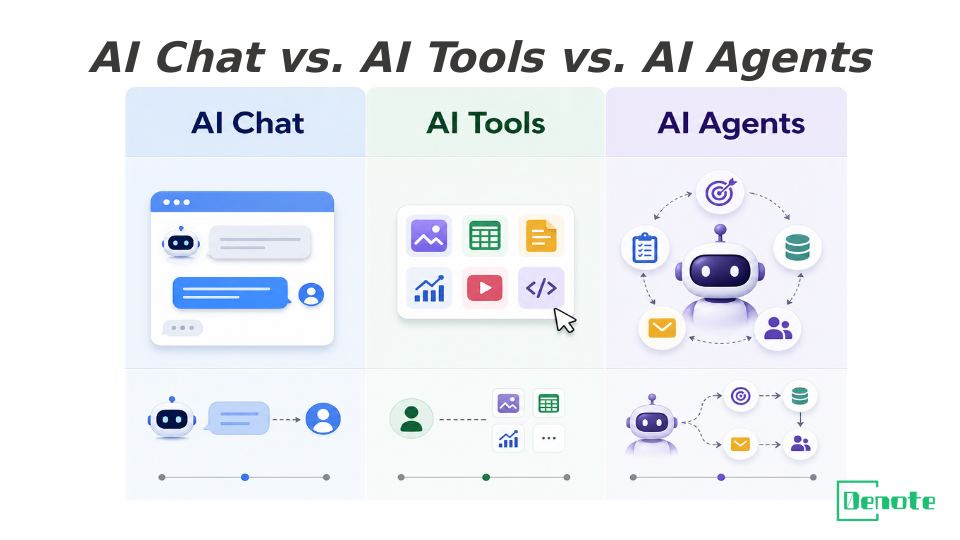
Not all "AI" in AI dropshipping does the same job, and mixing them up is why some sellers try one ChatGPT prompt, get a generic answer, and decide AI dropshipping doesn't work.
- AI chat (ChatGPT, Claude, Gemini) is for thinking out loud — brainstorming ad hooks, drafting copy, summarizing an idea. It only knows what you type in; it can't see your store, your ads, or your sales data.
- AI tools are built for one specific job inside the dropshipping workflow — generating a product description, filtering an ad library by spend and running days, or turning a product photo into an ad creative. Each tool does one thing and connects to real data (ad libraries, supplier catalogs, store platforms) rather than working from scratch.
- AI agents go a step further, acting on live store or ad data rather than just answering a prompt — for example, pulling this week's top-spending competitor ads automatically instead of you searching for them manually.
Knowing which category a tool falls into helps set the right expectation: a chat tool won't replace dedicated ad research software, and dedicated software won't brainstorm a creative angle from scratch the way a chat tool can.
How Does AI Help With Dropshipping? (Ways to Use It)
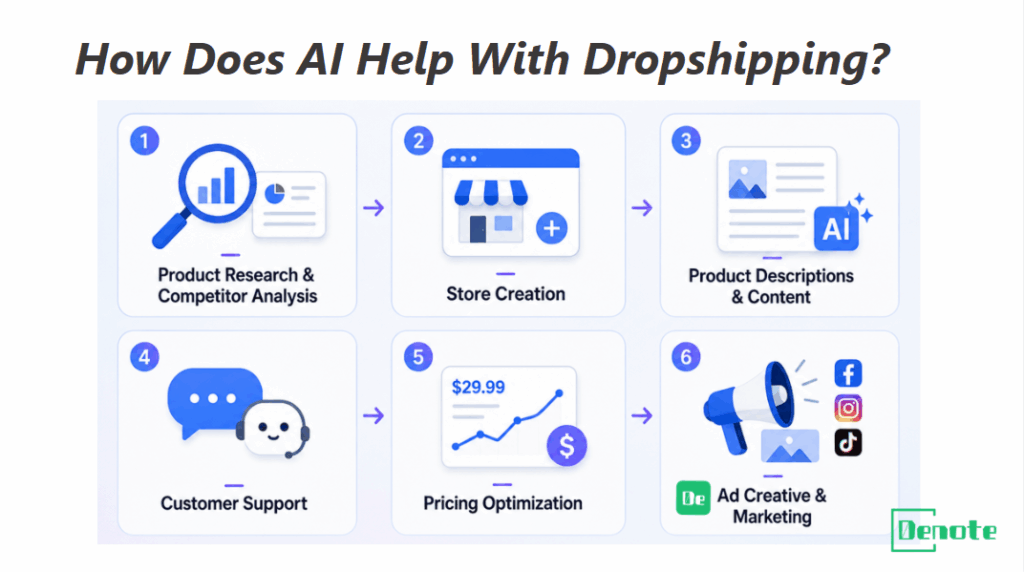
Knowing how to use AI for dropshipping starts with knowing which task you're trying to speed up — AI plays a different role at each stage of the business. Here are the six areas where it makes the biggest difference.
Product Research & Competitor Analysis
AI helps with dropshipping product research by scanning ad libraries and store data to surface signals a human would take hours to spot manually — which ads have been running for weeks, how ad spend is trending, and which niches are heating up. Instead of manually scrolling TikTok or refreshing the Facebook Ad Library, AI tools can filter thousands of ads down to the ones actually worth a closer look, based on running days, spend, and engagement.
This is also the stage where AI adds the most value relative to manual work, because ad data changes daily and a human researcher can only track so many competitors at once.
Store Creation
AI store builders can turn a few keywords or a product niche into a ready-to-launch storefront — generating layouts, pages, and even initial product listings without touching a page builder manually. This shortens the gap between deciding on a niche and having a live store to test it in.
Product Descriptions & Content
AI writing tools generate SEO-optimized product descriptions, titles, and page copy in seconds, pulling from a product's specs or supplier listing. This matters most for stores adding dozens of products at once, where writing unique copy by hand for every listing isn't realistic.
Customer Support
AI chatbots handle routine questions — shipping times, order status, return policies — around the clock, escalating only the more complex conversations to a human. For a small dropshipping team, this is often the single biggest time-saver, since customer questions don't stop outside business hours.
Pricing Optimization
AI pricing tools monitor competitor prices, demand signals, and your own margins in real time, then suggest or automatically apply price adjustments. This helps stores stay competitive without someone manually checking competitor pricing every day.
Ad Creative & Marketing
AI ad tools can generate image or video ad creatives directly from a product link or photo, along with ad copy variations to test. This speeds up the part of the process that used to require a designer or a UGC creator for every new product test.
Top 10 AI Tools for Dropshipping in 2026
The best AI tools for dropshipping aren't one-size-fits-all — each one is built for a different stage of the workflow described above. Here are 10 tools, grouped by what they're actually built to do.
Product & Ad Research
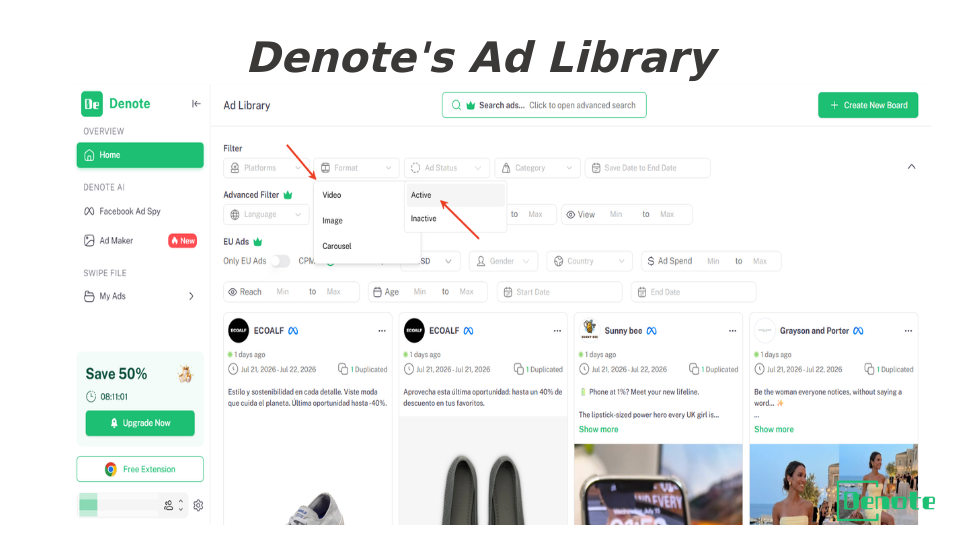
1. Denote — Best for ad spend and running-day tracking. Denote's Ad Library and Ad Spy features let you filter competitor ads by industry, region, and how long they've been running, with Ad Spend data showing whether demand for a product is climbing or fading over time. It's built specifically around validating a product before you source it, rather than just browsing ad inspiration.
2. WinningHunter — Best for high-volume, credit-free browsing. WinningHunter covers over 500,000 Facebook ads and around 100,000 TikTok ads daily, plus a store tracker for competitor revenue estimates, without a credit system limiting how much you can view.
Store Creation
3. Shopify AI Store Builder — Best for going from idea to live store fast. Type a few keywords describing your niche, and it generates a ready-to-use storefront with layouts and pages already in place.
4. AutoDS — Best for combining sourcing with store setup. AutoDS pairs one-click product importing with automated pricing rules and order fulfillment, so a new store can go from product list to live listings quickly.
Product Descriptions & Content
5. CopyAI — Best for bulk product copy. CopyAI generates product descriptions and marketing copy from a title and spec list, with tools for adapting content across languages and regional markets.
6. Jasper — Best for broader content beyond product pages. Jasper combines AI writing with an analytics layer, useful for stores that also need blog content or landing pages optimized for SEO.
Customer Support
7. Tidio — Best for 24/7 routine support. Tidio's chatbot handles common questions like shipping and returns automatically, passing more complex conversations to a human dashboard.
8. Gorgias — Best for support tied directly to order data. Gorgias connects customer conversations to order and shipping information, so AI-assisted replies can reference a specific customer's order without manual lookup.
Pricing Optimization
9. Pricen (formerly Sniffie) — Best for dynamic repricing. Pricen monitors competitor pricing and internal data like inventory levels to suggest or automate price adjustments that protect margins.
10. Prisync — Best for straightforward competitor price tracking. Prisync focuses on monitoring competitor prices across multiple marketplaces and alerting you to changes, without the broader automation layer of a full repricing tool.
Ad Creative & Marketing
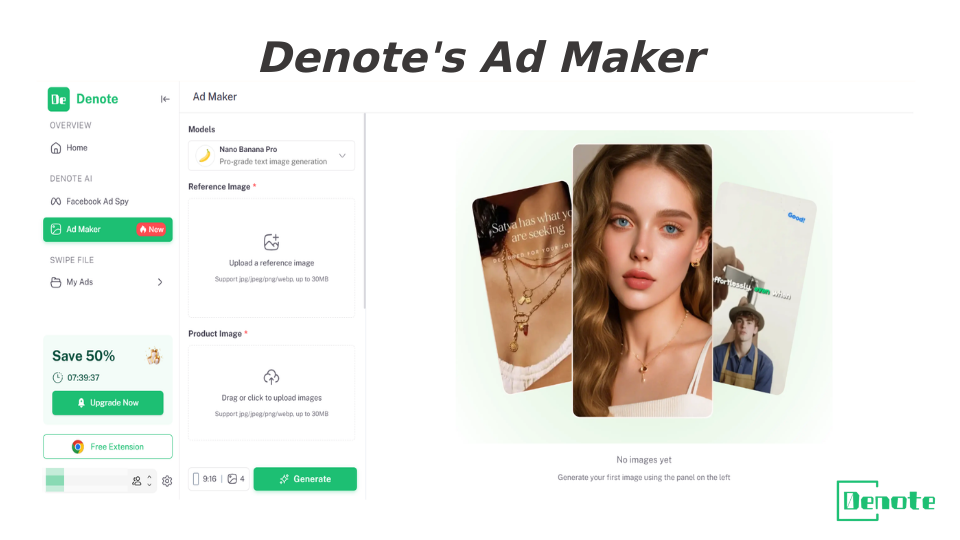
Denote (Ad Maker) — Best for turning a product link into a ready ad. Beyond its ad research features, Denote's Ad Maker generates image and video ad creatives directly from a product link, along with AI-written ad scripts and copy variations — useful for testing multiple creative angles on a new product without a designer.
What AI Can't Do for Your Dropshipping Business
AI dropshipping tools save real time, but a few things still need a human in the loop, no matter how good the tool is.
AI can't guarantee a winning product. It can surface signals — ad spend, running days, engagement — but customer demand is still decided by real buyers, not an algorithm. Test with real traffic before committing.
AI can't invent truthful product claims. AI-written copy can sound convincing without being accurate. Always verify anything related to health benefits, performance, materials, or shipping times before it goes live — inaccurate claims lead directly to refunds and complaints.
AI can't fix a bad supplier or fulfillment process. No amount of ad creative or store polish makes up for slow shipping or poor product quality. Vet suppliers and confirm fulfillment times before scaling spend on a product.
AI can't replace your margin math. Pricing tools can suggest adjustments, but you still need to confirm the numbers actually work for your cost structure before applying them store-wide.
The tools in this guide are built to remove repetitive work — not to replace the judgment calls that determine whether a dropshipping business is actually profitable.
FAQ
How do you dropship with AI?
Use AI tools to automate product research, store setup, content, pricing, and customer support tasks.
Is AI dropshipping profitable?
Yes, if you still validate products and manage margins — AI speeds up execution, not decision-making.
What is AI dropshipping?
AI dropshipping means using AI tools across product research, store creation, marketing, and support.
How does AI help with dropshipping product research?
AI analyzes ad spend, running days, and trends to help validate demand before you source a product.
What are the best AI tools for dropshipping?
Top picks include Denote for ad research and creative, AutoDS for automation, and Tidio for support.
Can AI find winning dropshipping products for me?
AI can surface signals like ad spend and longevity, but you still need to validate and test products.
Is there a free AI tool for dropshipping?
Many tools, including Denote, offer free trials rather than fully free plans for ongoing use.
Does AI replace manual dropshipping research?
No — AI speeds up research and screening, but sourcing and validation still need human judgment.
How much does AI dropshipping software cost?
Most tools range from $10–$100+/month depending on features like automation and ad research depth.
What's the easiest way to start using AI for dropshipping?
Start with one task, like AI product research or store building, before adding more tools.


