
In the hyper-competitive landscape of 2026, data-driven marketing isn't just a buzzword, it's a survival requirement. Facebook's auction-based advertising system is essentially a zero-sum game for attention. If you aren't analyzing what your competitors are doing, you are effectively flying blind while your rivals use high-precision radar.
This guide provides a comprehensive framework for deconstructing competitor strategies, identifying high-performing creatives, and turning those insights into your own winning campaigns.
Why Researching Competitor Ads Gives You an Unfair Advantage
Many marketers view competitor research as a "one-and-done" task. In reality, it is a continuous intelligence loop that provides the blueprint for market demand.
The Shift from Quarterly Audits to Real-Time Intelligence
Gone are the days of the static PDF "Competitor Analysis Report" updated once every three months. In 2026, creative fatigue happens in days, not months. Winning brands have shifted to real-time intelligence. By monitoring ads as they launch, you can identify a competitor’s new testing phase before they even scale their budget, allowing you to counter-position your offer immediately.
What Competitor Ad Research Actually Reveals
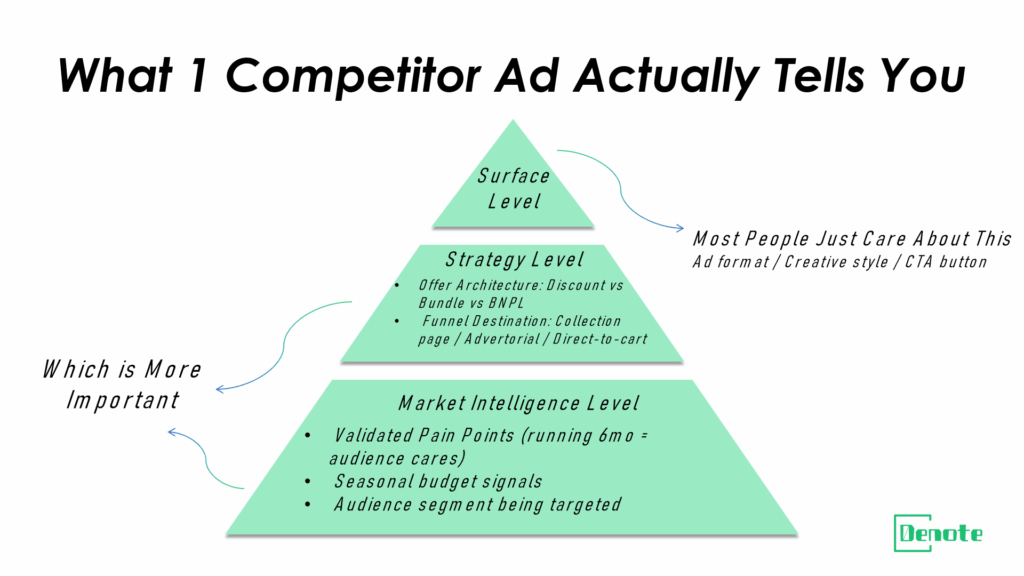
It's not just about "what they're running." Deep research reveals:
- Validated Pain Points: If a competitor has been running an ad focused on "fast shipping" for six months, you can bet that shipping speed is a primary conversion driver for your shared audience.
- Offer Architecture: Are they leading with a discount, a bundle, or a "buy now, pay later" message?
- Funnel Strategy: By clicking through, you can see if they are driving traffic to a collection page, a high-converting advertorial, or a direct-to-cart checkout.
The Risk of Skipping Competitor Research in 2026
With rising CPMs and the increased role of AI in Facebook’s ad delivery (like Advantage+ campaigns), the creative is the only lever left to pull. Skipping research means you are wasting your testing budget on concepts that have likely already failed for others in your niche.
Where to Find Your Competitors' Facebook Ads
You don't need to be a private investigator to find this data. There are two primary avenues: official transparency tools and specialized analysis software.
Meta Ad Library: The Free Starting Point
The Meta Ad Library is a public database of every active ad running across Facebook, Instagram, Messenger, and Audience Network.
- How to Search: You can search by Brand Name (to see a specific rival) or by Keyword (to see broader industry trends).
- Filters that Matter:
- Country: Check if they are testing different angles for different markets (e.g., US vs. UK).
- Media Type: Filter by video to see their UGC (User Generated Content) strategy.
- Date Range: Look for ads that have been active for 30+ days; these are their "winners."
- Limitations: The library only shows active ads. It won't show you the graveyard of failed ads, nor does it provide performance metrics like CTR or spend.
Third-Party Facebook Ad Analysis Tools
To overcome the limitations of the Meta Ad Library, professional media buyers use specialized software.
- Tracking Creative Over Time: Tools that "archive" ads even after they stop running are vital for understanding a brand’s seasonal trajectory.
- Alert Systems: Receive a Slack or email notification the moment a competitor launches a new creative.
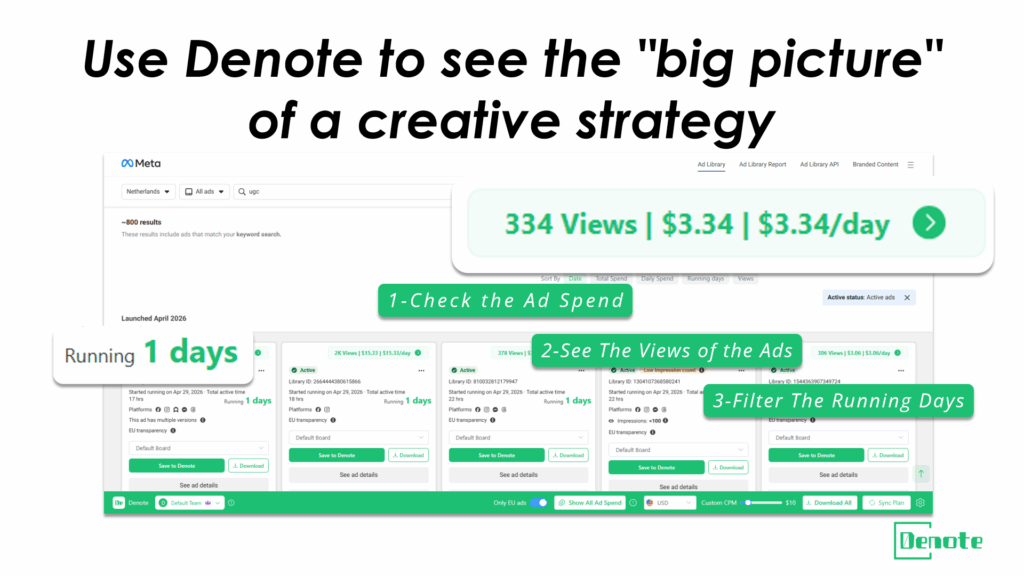
- Creative-Level Analysis: Platforms like Denote allow you to aggregate data and see the "big picture" of a brand’s creative strategy.
How to Analyze Competitor Ads Like a Pro (6-Step Framework)
Don't just look at the ad; deconstruct it. Use this 6-step framework to audit any creative.
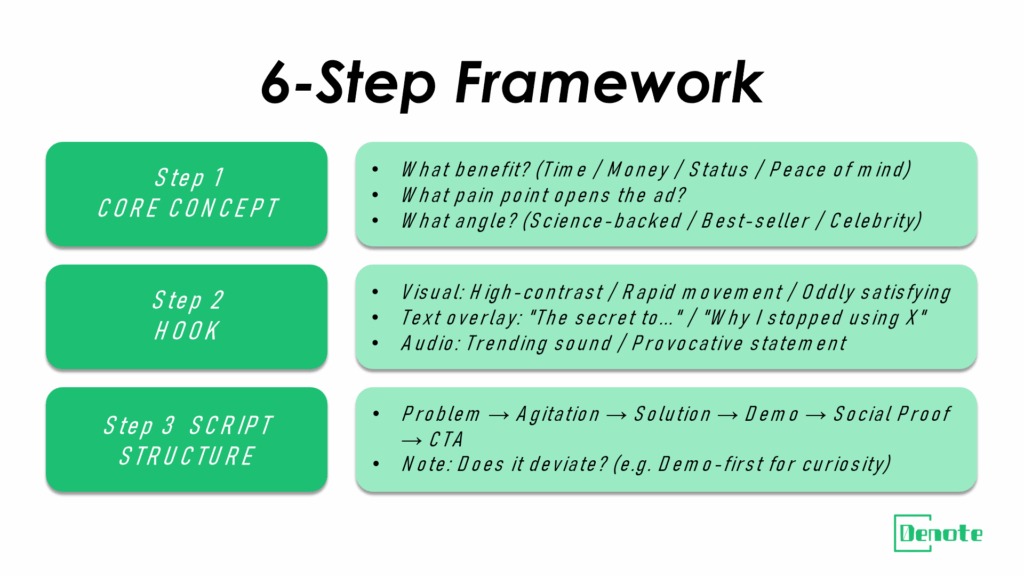
Step 1: Identify the Core Concept
Every ad is built around a single "Big Idea." Ask yourself:
- What Benefit? Are they selling time, money, status, or peace of mind?
- What Pain Point? What specific frustration does the ad open with?
- What Angle? Is it "Science-backed," "Best-selling," or "Celebrity-endorsed"?
Step 2: Decode the Hook
The hook is the first 3 seconds of the video or the first line of copy. It is designed to "stop the scroll."
- Visual Hooks: High-contrast colors, rapid movement, or "oddly satisfying" clips.
- Text Overlay: "The secret to..." or "Why I stopped using [Competitor]."
- Audio: Trending sounds or a provocative opening statement.
Step 3: Map the Script Structure
If it's a video ad, it likely follows a proven psychological structure. The most common is Problem → Agitation → Solution → Demo → Social Proof → Call to Action (CTA). Notice if they deviate from this—for example, leading with a demo to build immediate curiosity.
Step 4: Study the Visuals
The "vibe" of the creative tells you who they are targeting.
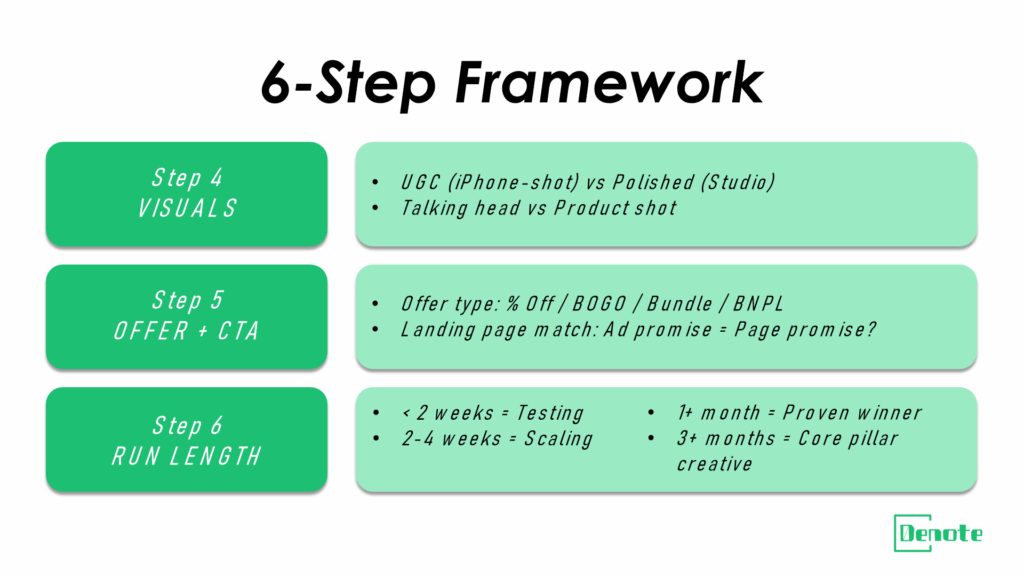
- UGC vs. Polished: Are they using raw, iPhone-shot footage (highly effective in 2026) or high-end studio production?
- Talking Head vs. Product Shot: Do they rely on influencers to tell the story, or does the product speak for itself?
Step 5: Analyze the Offer and CTA
Look at where the "friction" is removed.
- The Offer: Is it a "First Order 20% Off" or a "Buy 2 Get 1 Free"?
- The Destination: Click the ad. Does the landing page match the ad’s promise? If the ad talks about a specific feature but the landing page is a general homepage, that’s a gap you can exploit.
Step 6: Track Over Time
This is the "Golden Rule" of ad research. Length of run = Performance. If an ad has been active for months, it is making the company money. Note the seasonal shifts, when do they start their Black Friday testing? When do they pivot to New Year's resolutions?
What to Look for Across Competitors' Facebook Ad Strategies
When you look at 10 competitors at once, patterns emerge.
- Creative Format Mix: If 80% of your competitors are using Carousels, but you are only using Single Images, you are missing a format the audience clearly prefers.
- Messaging Angles: Identify "Positioning Gaps." If everyone is talking about quality, perhaps you can win by talking about sustainability or ease of use.
- Audience Signals: Read the comments on their ads. What are people asking? "Does it come in blue?" "Is it vegan?" These questions are literal instructions on what you should include in your next ad.
- Refresh Rate: A brand that launches 50 new ads a week is likely spending five to six figures daily. A brand that hasn't changed its ads in six months is likely stagnant.
How to Turn Competitor Insights into Your Own Winning Ads
Insight without action is just trivia. Here is how to apply what you've learned.
- Don't Copy Iterate: Copying a competitor puts you one step behind. Instead, take their winning concept and add a "Unique Selling Proposition" (USP) that they lack.
- Build a Swipe File: Use a Facebook ads analysis tool to save top-performing ads into folders organized by "Hook," "Offer," or "Format."
- The Creative Brief: Give your designers a specific brief: "We want a UGC video using the 'Problem/Solution' structure seen in [Competitor A's] ad, but using our 'Sustainability' angle."
- Prioritize Testing: Use the market’s data to prioritize your tests. If "Unboxing" videos are working for everyone else, make that your first test.
Common Mistakes When Researching Competitor Ads
- The Snapshot Fallacy: Looking at the Ad Library once and assuming that's the whole strategy. You must track them over weeks to see what they kill and what they scale.
- Ignoring "Ugly" Ads: Many marketers dismiss raw or "amateur" looking ads. In 2026, these often outperform high-production videos because they feel native to the social feed.
- Focusing Only on Direct Rivals: Sometimes the best inspiration comes from "adjacent" categories. If you sell skincare, look at what high-growth supplement brands are doing.
Leveraging AI and Automation to Scale Your Ad Intelligence
In 2026, manual research is the bottleneck of creative strategy. Top-tier media buyers are no longer spending hours scrolling through the Ad Library; instead, they are using AI to synthesize competitor data into actionable creative briefs.
Automating the "Boring" Parts of Research
The most time-consuming part of competitor research is data collection. By using advanced platforms like Denote, you can automate the archiving of every new ad your competitors launch. This creates a "living library" that you can access even after the competitor takes the ads down—giving you a permanent record of their testing history.
Using LLMs to Deconstruct Ad Copy
Once you have collected the ad copy from your rivals, you can feed it into AI models (like GPT-4 or Claude) to perform a Sentiment and Hook Analysis.
- Identify Patterns: Ask the AI to find the common denominator in 50 competitor headlines. Is the focus on "Urgency," "Curiosity," or "Authority"?
- Rewrite and Improve: Take a winning competitor hook and prompt the AI: "Give me 10 variations of this hook for my brand, keeping the psychological trigger but changing the value proposition."
AI-Driven Video Intelligence
One of the biggest shifts in 2026 is the ability to analyze video frames automatically. Specialized Facebook ads analysis tool can now transcribe competitor videos and identify exactly which "scene" causes the highest engagement.
- Scene Detection: Does the competitor always show the product in the first 0.5 seconds?
- Transcript Mining: What specific keywords are they using in their voiceovers to bypass ad fatigue?
Building a "Predictive" Creative Roadmap
By analyzing the frequency and volume of a competitor’s creative refreshes, AI can help you predict their next move. If a competitor suddenly increases their "UGC-style" output by 300% in a single week, it’s a predictive signal that this format is currently yielding their lowest CPA. This allows you to pivot your production resources before the trend becomes oversaturated in your niche.
FAQ: Researching Competitor Facebook Ads
How do I find a competitor's Facebook ads for free?
Use the Meta Ad Library. It is the most comprehensive free tool available, though it requires manual work to track changes over time.
How do I know which competitor ads are actually performing well?
Look at the start date. Any ad that has been active for more than 2-3 weeks is likely hitting its KPI targets. Brands do not waste money on non-performing ads for long.
How often should I research competitor ads?
At a minimum, do a deep dive once a month. However, high-growth brands typically monitor their top 3-5 rivals weekly to catch new promo launches.
What's the difference between Meta Ad Library and a dedicated ad analysis tool?
Meta Ad Library is a "live view" only. Dedicated tools provide historical data, auto-saving of creatives, and analytical dashboards that make it easier to see a brand's overall strategy at scale.


