
Ad angles are the reasons an advertisement gives someone to care about a product. To identify an angle, finish this sentence: “This product is worth choosing because…” Then point to the copy or visual that supports your reading.
A competitor message map puts those reasons beside their evidence and limitations. It helps you see whether your next creative offers a different argument or merely changes the opening, creator or layout.
The map below uses real ads found in Denote. It shows how to move from a visible claim to a testable message without pretending to know the advertiser's results.
TL;DR
- An angle is the argument; a hook introduces it; a format presents it.
- Record what the ad says or shows before assigning an angle label.
- Keep advertiser claims separate from independently verified product evidence.
- Compare direct competitors for your own message map. A teaching set across game types illustrates the method, not market share or an unserved audience.
- Choose an argument your product can support, then develop hook variations around it.
Ad angle, hook and format: use three different labels
An ad can change its first frame while keeping the same underlying reason to choose. It can also keep a familiar layout while introducing a different promise.
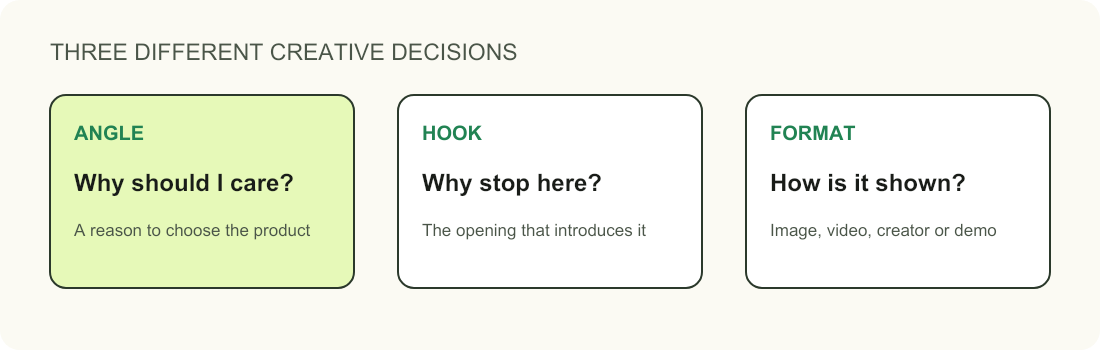
Editorial framework. These labels describe the creative, not Denote-generated performance findings.
Use the ad hooks guide when the argument is already chosen and you need opening variations. Use this guide when the team is still deciding what it should argue.
The real references behind this message map
On October 22, 2026, we inspected selected creatives from Denote's Game Trending chart for October 12–18. The all-format discovery view used All tags, platforms, regions, languages and operating systems, with Remove Re-ads off. We also inspected the same week's Image-filtered view for the two static references.
The selection contrasts different games and creative approaches. It is not a matched competitor study or a measurement of which angle dominates the market. Video observations use sampled opening and later frames, rather than a continuous playback review; static observations cover the visible image and copy. No budget, conversion or revenue conclusion follows from their presence in the chart.
Sources: all-format Game Trending chart and the same week filtered to Image. Access and available results can vary.
A filled ad angle map from four real references
The labels are our interpretation of these specific executions. They are not an exhaustive description of each brand, and they do not establish what the advertiser intended for every audience.
Royal Kingdom: distinguish the attention device from the reason to play
The rocks and confined character create an immediate problem. The puzzle board provides an implied way to act. The hook is the urgent visual situation; the possible angle is the satisfaction of resolving it.
This distinction changes the brief. Copying the threat while removing the meaningful decision would preserve an attention device but weaken the argument. A team adapting the principle should first identify a genuine product interaction with a clear consequence.
Supremacy: specificity is part of the proposition
The opening's map and historical context define a particular fantasy. Its appeal is narrower than a generic promise of entertainment: the viewer is invited to follow a strategic scenario.
The useful research question is whether your own category benefits from that specificity. If your product supports a distinct use case, era, role or decision, it may provide a clearer argument than a broad feature list. The ad alone cannot tell you whether that narrower positioning expanded or reduced qualified demand.
Invincible: progression is a claim that needs a boundary
The static reference uses a side-by-side character presentation and an earlier/later time contrast. Its caption connects the product to idle battles and accumulating resources.
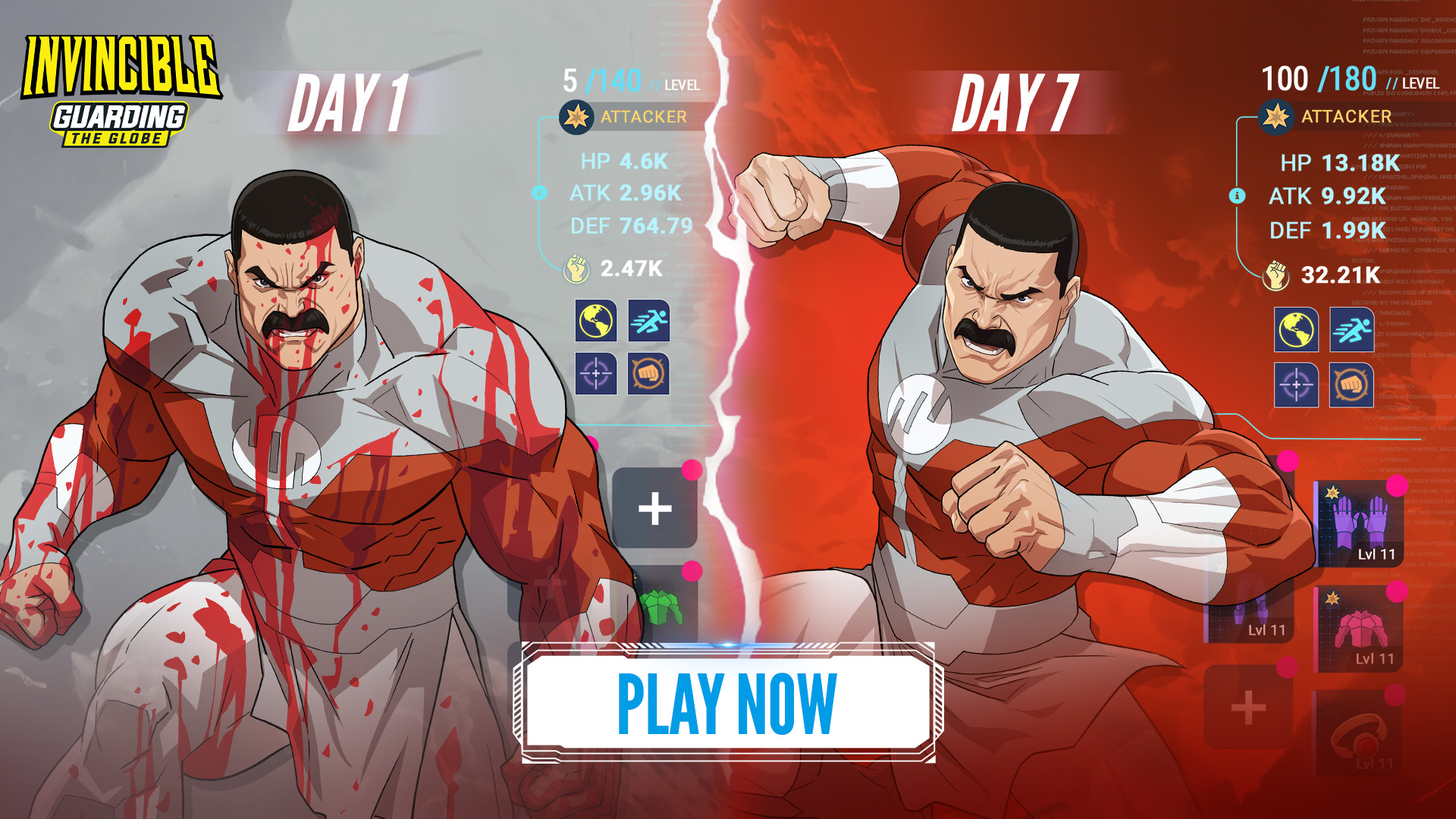
Original image ad displayed in Denote's Game Trending Image view, recorded October 22. The time comparison and stats are advertiser creative, not independently verified outcomes.
This is a useful progression reference because the composition makes change visible. It is not evidence that a new user will achieve the depicted state within the advertised time. For your own brief, define what claim you can substantiate before choosing the visual contrast.
Crossmath: the demonstration can carry the message
The Crossmath image contains an incomplete arithmetic grid. Instead of requiring a long explanation, the composition gives the viewer a small problem to inspect. Its daily-puzzle caption frames that challenge as a repeatable activity.
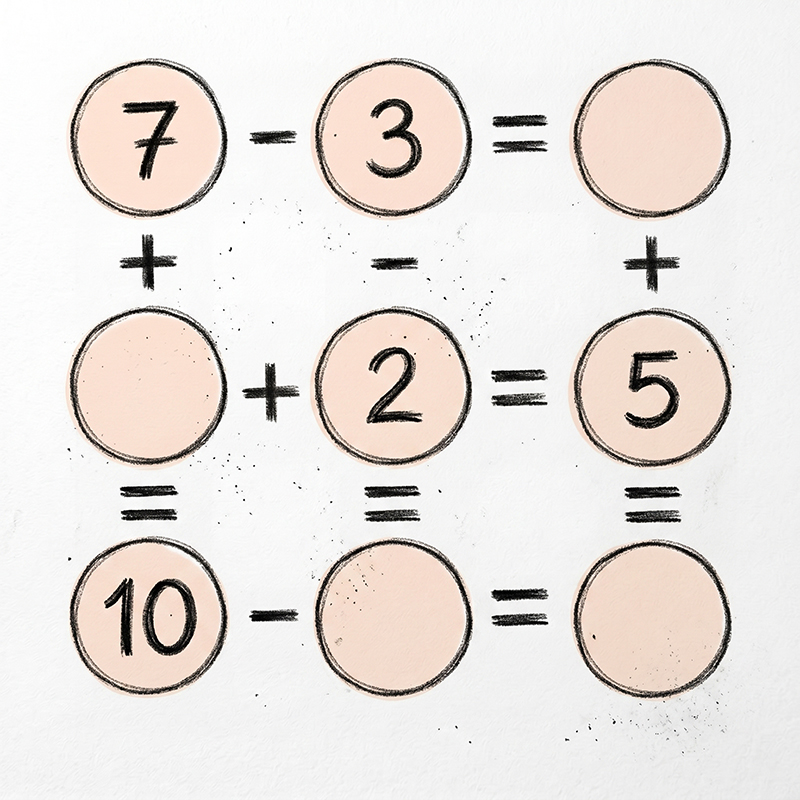
Original Crossmath image ad displayed in Denote, recorded October 22. We inspected the creative; we did not test puzzle difficulty or retention.
The possible angle is a compact mental challenge. The mechanism may transfer to products that can demonstrate a useful task immediately. It does not justify claiming cognitive improvement or a health benefit.
Build your own competitor message map
1. Define the purchase or usage decision
Write the audience and the choice they face. A game team might focus on a player choosing a new puzzle title. An app team might focus on someone replacing a manual task. Those are different decisions and should not share one undifferentiated competitor list.
Include direct alternatives and explain why each belongs. Adjacent-category references can help with execution ideas, but keep them separate from the set used to describe competitor positioning.
2. Capture claims before assigning categories
For every reference, save the source, date, format, visible promise, demonstration, objection addressed and destination. Quote only the wording needed to support the analysis.
If you cannot point to a phrase or visual, mark the proposed angle as uncertain. A familiar label such as “social proof” should follow actual evidence of endorsement or customer use, not a guess based on an attractive layout.
3. Separate repetition from variety
Several ad rows can repeat one argument with different crops, languages or opening scenes. Group those variants before concluding that the advertiser uses several angles.
Conversely, one familiar format can contain different arguments. Two comparison images might sell convenience and progression respectively. Layout similarity alone is not a message category.
4. Look for a supportable alternative
An angle absent from your reviewed sample is not observed in that sample. It is not automatically an untapped market opportunity. You may have missed a region, period, channel or creative variant.
A worthwhile candidate must pass two checks: it matters to your audience, and your product can substantiate it. A clever argument that your product cannot deliver should not enter production.
From the map to an original message test
The following is a hypothetical plan for an imaginary puzzle product, not a report about the source advertisers.
Choose one argument, write the claim boundary, and then make opening variations. If the argument changes, name it as an angle test; if only the introduction changes, name it as a hook test. This makes later interpretation clearer without pretending that creative tests are free from audience, delivery or measurement effects.
The ad testing guide and brief-writing guide provide related planning context. Use your own campaign reporting and product analytics to judge the result.
A copyable message-map template
For a fuller ad-by-ad breakdown, continue with the creative analysis worksheet.
FAQs
How many ad angles should a brand test?
Choose enough to represent meaningful, supportable arguments within your production and measurement capacity. A long list of synonyms is less useful than a small set of distinct reasons to choose.
Can I infer the winning angle from ad duration?
No. Duration and chart visibility can identify references to inspect. They do not reveal the advertiser's revenue, profit or reason for keeping an ad active.
Does Denote automatically create this message map?
The map here is an editorial analysis of inspected references. You can begin in Top Ads for Game or Tool discovery, Ad Library for broader research, or Ad Spy for Facebook advertiser context. The completed map and interpretations shown here are not claimed as an automated product output.
Method disclosure: this AI-assisted guide uses recorded Denote previews. The angle labels and proposed tests are editorial interpretations; advertiser claims and actual product evidence remain separate.


