.jpg)

Mobile game ads are easier to learn from when you separate what the creative shows from what a chart measures. In Denote's completed September 28–October 4, 2026 Game charts, we opened four ads with different opening approaches: a world reveal, character customization, challenge copy, and a relatable task scene. Each is a candidate for creative research, not evidence of profitable acquisition.
The examples below come from New Ads and Rising Ads, checked October 8, 2026. The lists use different ranking measures, so their ranks and scores are reported in separate tables.
TL;DR
- PUBG MOBILE used an environment-led opening tied to an ocean-adventure message. Test whether a real event-world reveal beats an action-first opening for your own game.
- Honor of Kings showed a customization frame and “Custom Your Flowborn” copy. Test whether player identity is a stronger first promise than a broad hero montage.
- Block Blast! paired “Can you beat the final move?” copy with a first frame that did not yet show the puzzle. Check the complete handoff before borrowing a challenge hook.
- A Gardenscapes Rising ad opened on a grocery-style task. Its chart growth is a reason to inspect the ad, not proof that this scene drove installs.
- Run any adapted hook with your own assets and measure the result against a control. Do not infer ROAS from the charts.
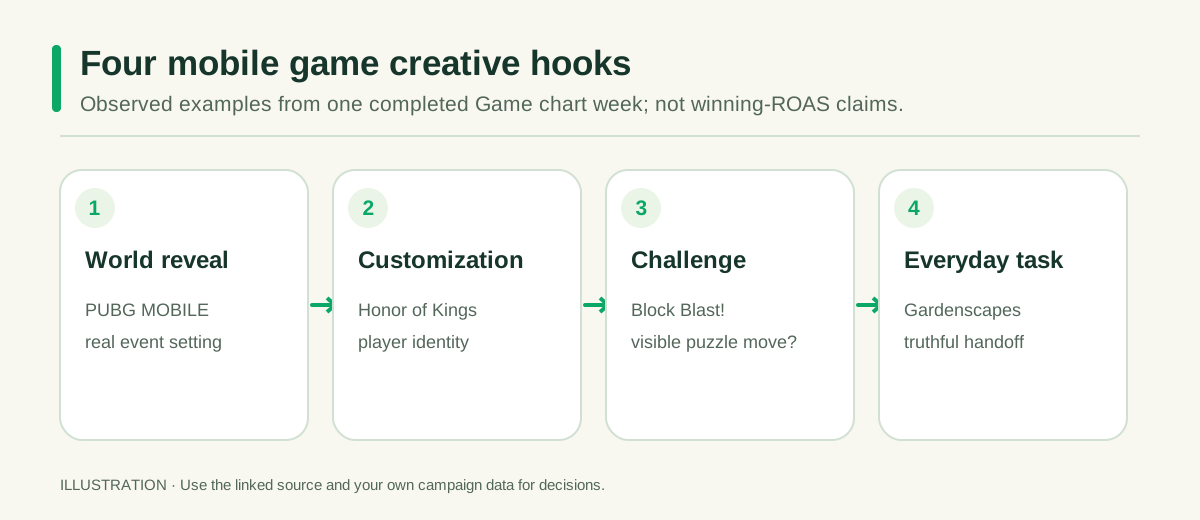
Illustration: four opening mechanisms to inspect, not a ranking of campaign performance.
How we selected these mobile game ads
We used the Game category and the same completed week, September 28–October 4, 2026, in both boards. The visible settings were All tags, platforms, countries, languages, and operating systems; Image & Video formats; and Remove Re-ads off. We screened the first 12 visible rows in each chart, then opened four previews because they illustrated distinct creative mechanisms. This is an editorial selection from visible rows, not the top four ads across the market or an exhaustive sample.
The figures below are the rounded values displayed by the Denote Workspace interface when checked on October 8. We did not combine chart ranks, add values across weeks, or use Denote's estimated “ads found” totals as a market denominator. In New Ads, “new” means newly observed by this chart, not a verified first-ever launch on every platform. In Rising Ads, the increment and rate are changes in the chart's weekly creative popularity score, not spend or installs. Denote Top Ads is the starting point for repeating this review with your own filters and access level.
New Ads: three different ways to open a video
Source: Denote New Ads → Game, September 28–October 4. The score is a weekly popularity score. It is not impressions, conversions, or revenue. The previews establish what we could see in the opened ads; they do not reveal targeting or the full campaign plan.
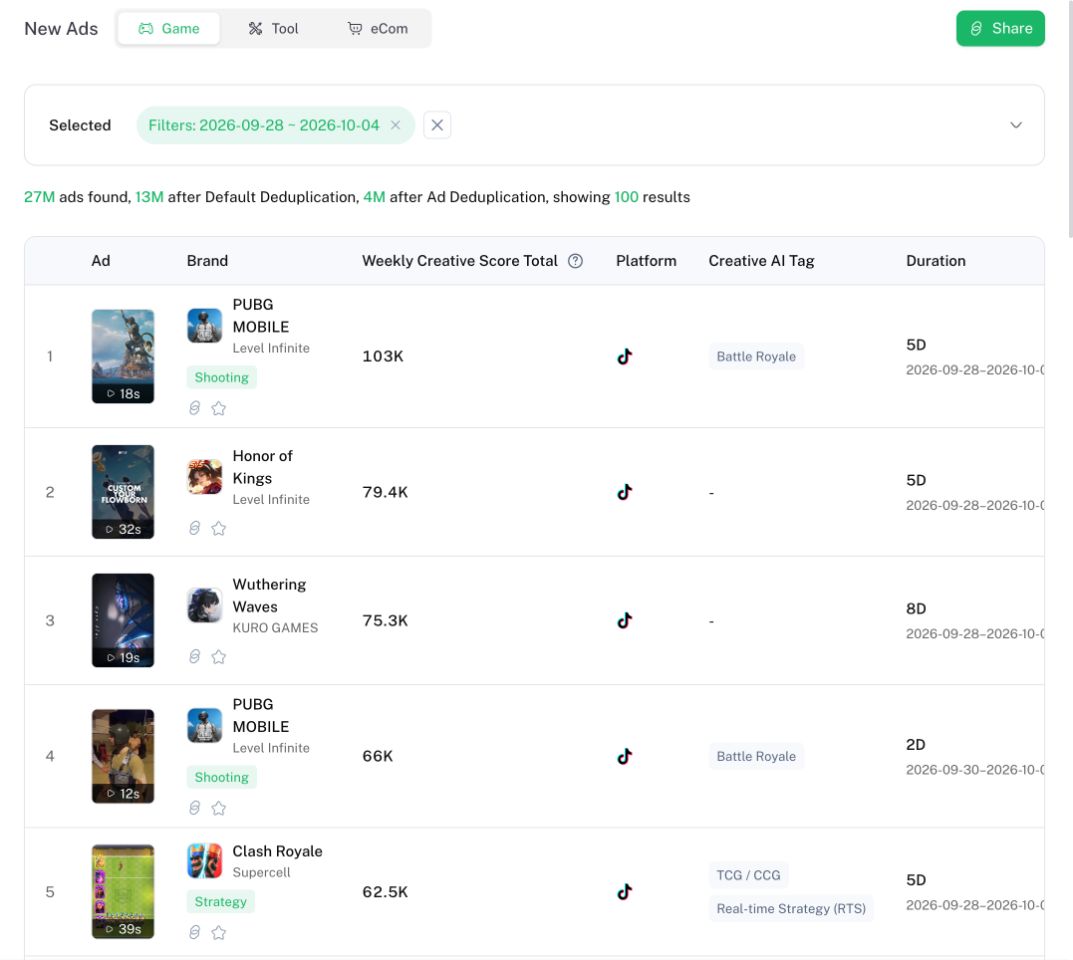
Product screenshot: New Ads → Game, September 28–October 4, 2026, captured October 9. Ranks and Weekly Creative Score Total belong to this selected chart and filter set.
Rising Ads: one task-scene example
Source: Denote Rising Ads → Game, September 28–October 4. The preview showed a grocery-style checkout scene with the line “Time for a break!” The displayed percentage is relative to the chart's comparison period; we do not know the campaign's spend, audience, or install results from it.
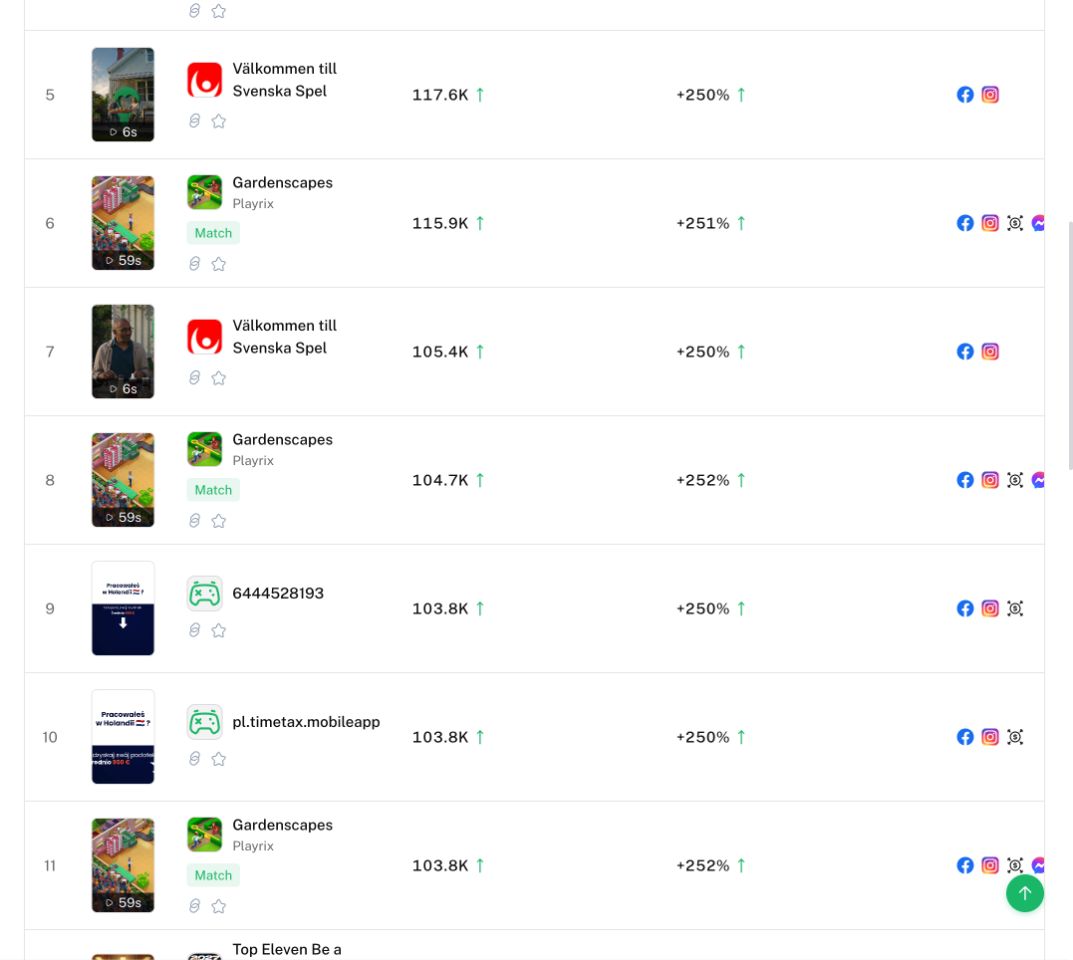
Product screenshot: Rising Ads → Game for September 28–October 4, captured October 9. The Gardenscapes row shows a 104.7K Weekly Creative Score Increment and +252% score growth rate; neither measures installs or revenue.
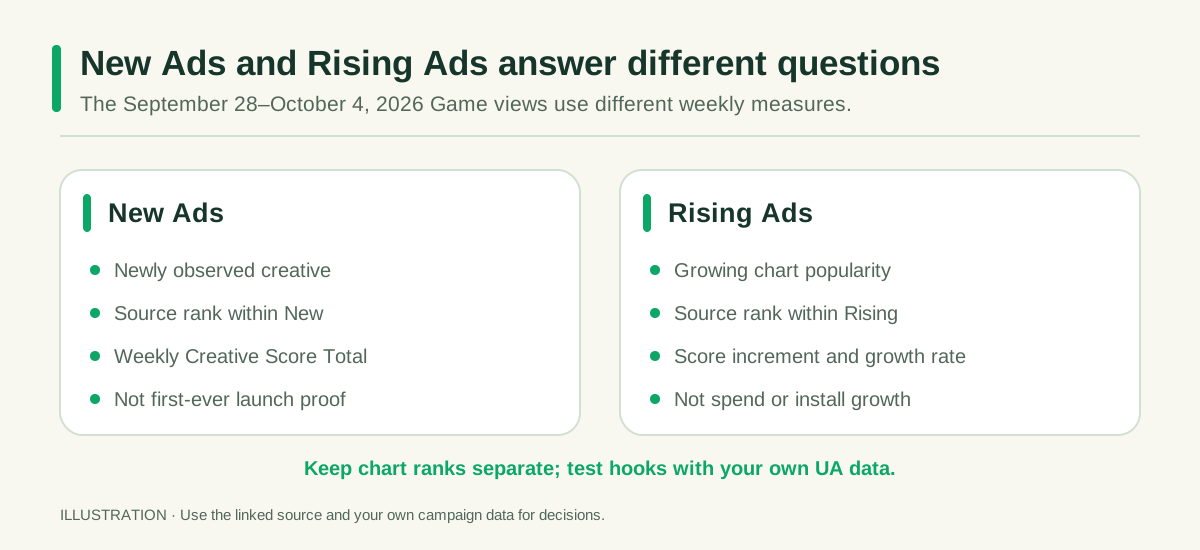
Illustration: New and Rising ranks belong to separate charts; neither is a return-on-ad-spend measure.
Creative lesson 1: Show a world the player can actually enter
The opened PUBG MOBILE preview begins with a large waterside environment and a statue-like structure. Its Turkish text refers to an ocean-adventure mode. The opening spends its first visible moment on a place rather than immediately showing a gunfight. That is a recognizable way to introduce an event or game world to people who may already know the core gameplay.
For a UA team, the transferable test is an event-world reveal versus an action-first opening. Use an environment that really exists in your game, keep the event name and audience language accurate, and compare the resulting creative against your current control. The 103K chart score explains why this ad appeared in the selected New list; it does not tell us whether the world reveal caused the score or drove installs.
Creative lesson 2: Make customization the first promise
The Honor of Kings preview shows a character inside a customization-oriented frame, while the visible copy says “Custom Your Flowborn.” The ad opens with a player-identity cue rather than a generic list of characters. This makes it useful for a team deciding whether to lead with who the player can become instead of only what the game contains.
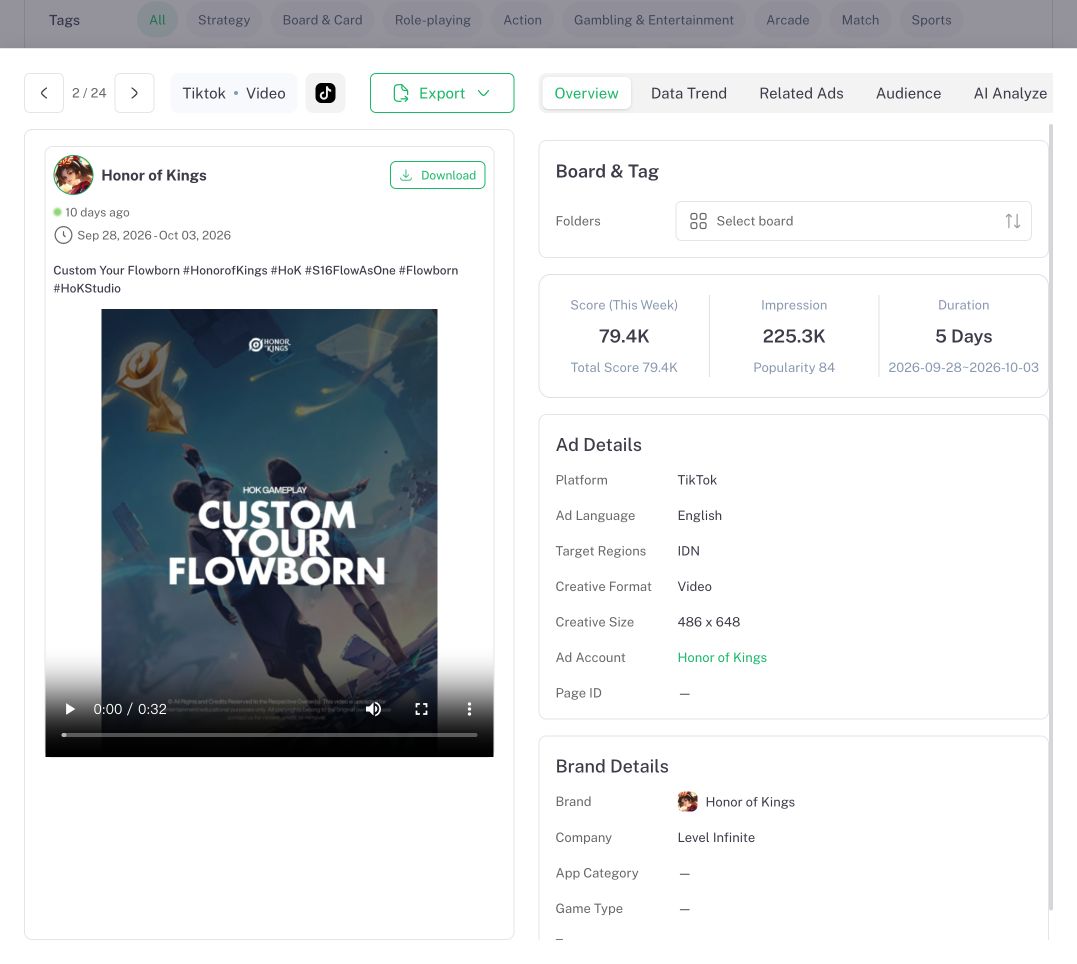
Product screenshot: the opened Honor of Kings creative in Denote New Ads, captured October 9, 2026. The visible frame supports the hook analysis; it does not show campaign results.
Test that question only if customization is real and central to your product. Show a genuine choice, the immediate visual result, and then the action the viewer can take in game. The source row's 79.4K weekly score does not disclose the video's completion rate or how many people installed the game.
Creative lesson 3: Check the gap between challenge copy and the first frame
The Block Blast! ad copy asks, “Can you beat the final move?”—a clear invitation to solve a puzzle. In the frame we captured when opening the preview, the visual instead showed a stylized character and a large “5000” reward-style number. The puzzle may appear later in the 59-second video; the first visible frame alone cannot establish the full sequence.
That gap is the useful research question. Would a puzzle game perform better if the actual decision appeared immediately alongside the challenge copy? Create an original ad that shows a real move from your game in the opening seconds, then test it against a version that builds curiosity first. Judge both with your own click, install, and player-quality data. Do not conclude that either approach won from the New Ads rank.
Creative lesson 4: Use an everyday task carefully
The opened Gardenscapes Rising preview showed a busy grocery-style checkout scene and the text “Time for a break!” The scene uses an everyday task and visual tension to invite attention before a viewer understands the broader game. That is a different mechanism from a direct match-3 board reveal.
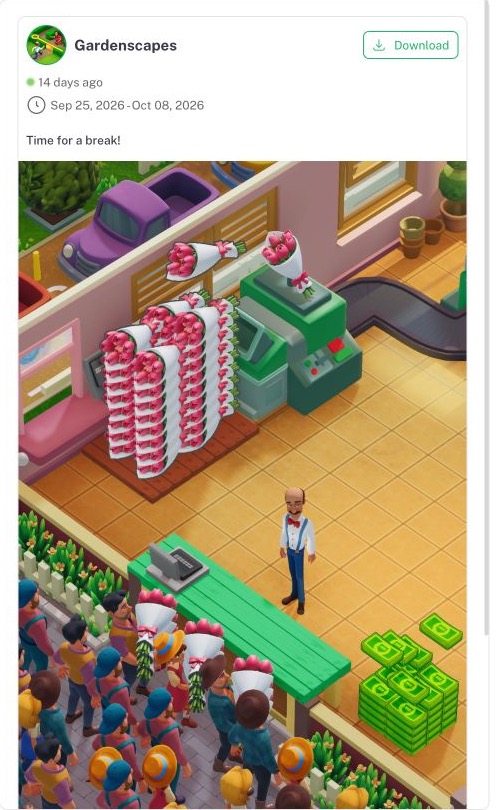
Product screenshot: the opened Gardenscapes creative in Denote Rising Ads, captured October 9, 2026. This frame shows the observed scene, not the ad's effect on installs.
The test question is whether a familiar task helps your audience understand the problem faster than an immediate gameplay view. If you use this structure, make sure the creative's promise matches an experience people can actually have in your game. The 104.7K weekly score increment and +252% growth rate are popularity changes within the selected chart. They do not verify that the task scene was responsible for the increase.
Turn the four hooks into a mobile game creative test plan
Do not produce four copies of the source ads. Write one hypothesis for each mechanism that your own game can support. A world reveal needs a real event or explorable place. A customization hook needs a genuine player choice. A challenge hook should show an actual decision the player can make. An everyday task should lead honestly into the game experience.
Choose the success metric before launch. A team optimizing for qualified installs may reach a different decision from one optimizing for retention or early payer quality. Keep the audience and store-page promise aligned with the ad, and do not use another advertiser's footage, music, character, or claims. For a broader weekly system, use the Game UA competitor-tracking workflow.
Compare mobile game ads across markets and weeks carefully
The four examples do not share a single language, placement, or creative promise. If you compare future weeks, preserve the chart type and filters before interpreting movement. If you compare countries, write the locale beside each observation and examine whether the hook depends on local language or a region-specific event. A score difference across unlike settings is a reason to ask a better question, not a market-size estimate. The Rising Ads research guide goes deeper on following creative movement over time.
What to test after reviewing these mobile game ads
Pick one mechanism that matches your game: a real event setting, a real customization choice, a visible puzzle decision, or a truthful everyday task. Write the opening frames, audience, locale, and store-page promise into one brief. Test against one existing control and decide in advance whether qualified installs, cost per quality user, retention, or another first-party measure will settle the result.
Repeat the review with the same chart type, week rule, and filters before comparing future results. New and Rising ranks answer different questions; keep them in separate columns of your research log. For a broader discovery-to-test process, read how to find winning ads. For another completed week's creative analysis, see four mobile game marketing lessons.
FAQ: mobile game ad creative research
Does “New Ads” mean these creatives launched for the first time that week?
No. It means the creatives were newly observed in the selected Denote chart. An advertiser may have used a related execution elsewhere earlier. Use the label to find research candidates, and keep the selected week and filters in the source note.
What does a +252% Rising score growth rate mean?
For the Gardenscapes row in this selected week, it is the displayed growth rate of the chart's weekly creative popularity score relative to its comparison period. It is not a 252% increase in spend, installs, retention, or revenue.
Are these the four best-performing mobile game ads of the week?
No. We screened the first 12 visible rows in each of two different charts and selected four distinct opening mechanisms for editorial analysis. New and Rising use different ranking measures. We do not have the advertisers' campaign outcomes.
Can a game team use these ideas in another genre?
Use the question, not the surface execution. A simulation game might test a truthful task opening; a strategy game might test a real choice or world reveal. If the advertised action does not exist in your game, choose another mechanism. Your own controlled creative test must settle whether it helps your players.
Where can I find more mobile game ad examples?
Start with Denote Top Ads under a completed Game week, then compare the source creative and metric label. Our weekly Game creative analysis and winning-ad research workflow provide complementary examples and a test-brief structure.
Explore Denote Top Ads to inspect the current completed week, then turn a verified observation into an original test. A chart can tell you where to look; your own campaign data tells you what works for your players.


