.jpg)

Updated October 23, 2026. This edition replaces the September case set with newly inspected October references.
Mobile game marketing campaigns become easier to study when you turn each reference into one creative decision: what player promise does it introduce, what action does it show, and what expectation might it create? The four real ads below illustrate a predicament, a historical scenario, a bounded task and character progression.
They came from Denote's completed October 12–18, 2026 Game Trending chart, inspected on October 22. The goal is a usable UA brief, not a claim about the advertisers' campaign returns.
TL;DR
- Royal Kingdom: a character problem and puzzle board appear together. Study whether the problem makes the action easier to understand.
- Supremacy: Call of War 1942: a historical map establishes a specific strategy scenario. Study how much context the intended player needs.
- Tasty Travels: an order slip and play area make a small task visible. Study whether the goal and input are clear.
- Invincible: Guarding the Globe: a static character comparison frames progression. Study the promise and the evidence needed to support it.
- Adapt the mechanism with your own assets and genuine game experience; judge it with your own campaign and player data.
How we selected these mobile game marketing examples
The source was Trending Ads → Game, October 12–18, using All category tags, platforms, countries, languages and operating systems; Image & Video formats; and Remove Re-ads off. We screened the first 12 visible rows. We also opened the same week's Image-filtered view to inspect the static example in its own format.
This is an editorial selection of four contrasting creatives across game types. It is not a direct-competitor cohort, an exhaustive market sample, or a ranking of entire campaigns. We inspected sampled opening and later frames from three videos, plus the full visible image/copy of one static ad. We did not continuously review the intervening footage or evaluate complete videos or audio tracks.
Platform labels above follow the resolved video detail rather than its temporary loading state. The chart's weekly creative score is a popularity signal. This edition intentionally focuses on creative observations and does not reproduce scores, spend estimates or impression estimates as evidence of acquisition success.
Lesson 1: Royal Kingdom makes the problem and action share the frame
The Royal Kingdom opening puts a king below a channel of rocks, with a match grid beneath the character. The sampled frames show a hand cue on the board. The composition gives the viewer both a reason to care and a candidate place to act.
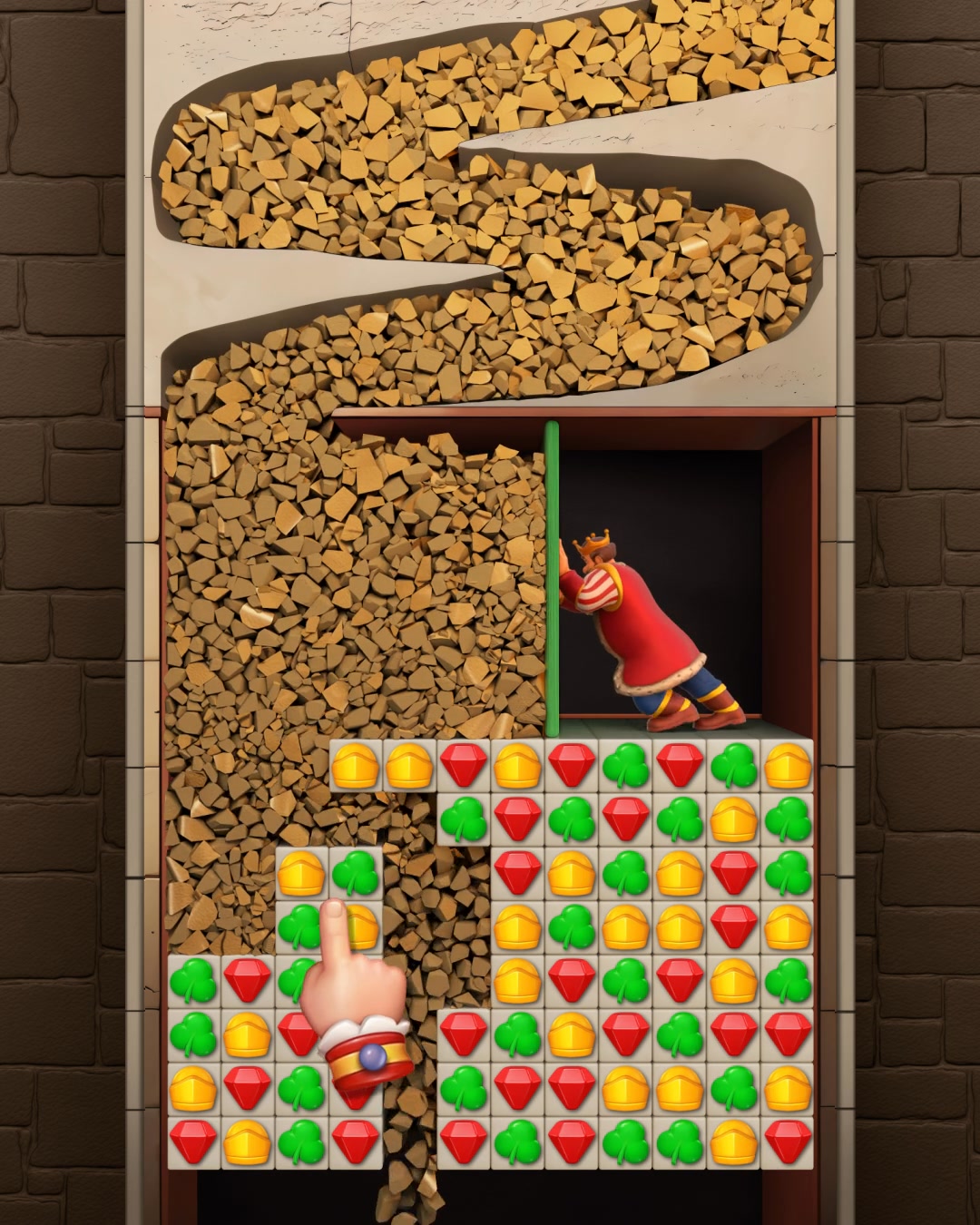
Original Royal Kingdom video poster displayed in Denote, recorded October 22. The image shows an advertiser execution, not an independently verified game sequence.
For a puzzle team, the useful lesson is action and consequence should be understandable together. A dramatic situation alone may attract curiosity without explaining the game. A board alone may explain the mechanic without introducing a goal. This execution places both in view.
Before adapting it, check the relationship in your own game. Does the move actually change the depicted problem? Is that experience available after the click? The source preview cannot establish the full product experience for us.
Proposed test: use the same genuine level in two openings. Show the problem and decision simultaneously in one; introduce them sequentially in the other. Keep the later footage and destination stable enough to interpret the comparison. Evaluate qualified acquisition and early player behaviour, not attention alone.
This is an original test proposal, not a reported Royal Kingdom experiment.
Lesson 2: Supremacy introduces a specific strategic fantasy
The Supremacy reference begins on a labelled map of Britain with a historical invasion scenario. The later sampled frame adds unit symbols, routes, effects and territorial colour. The caption positions the product as a World War II simulator.
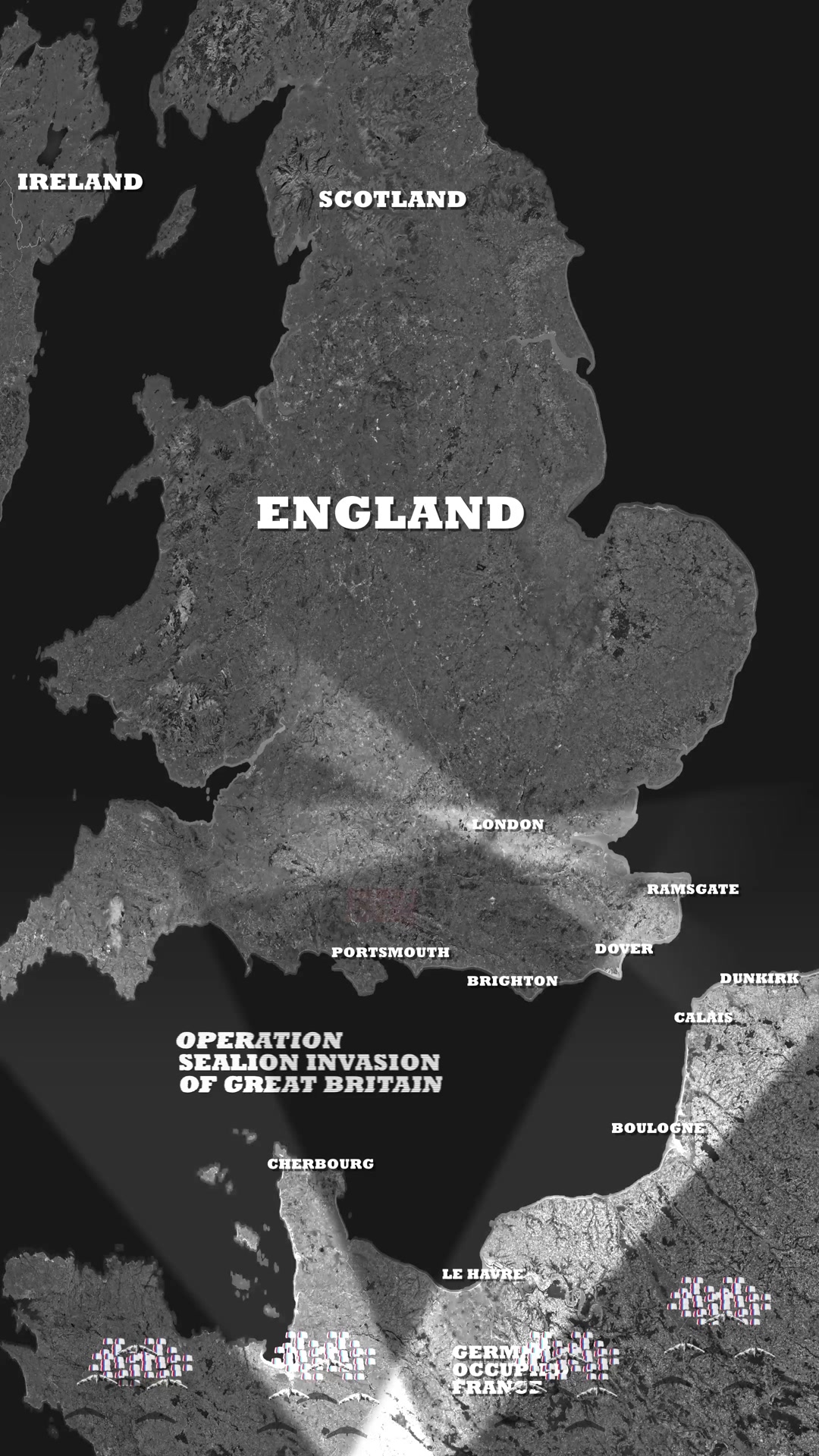
Original Supremacy video poster displayed in Denote, recorded October 22. The image does not establish the full video narrative or historical/gameplay accuracy.
The scenario gives the audience context before a detailed feature explanation. Its possible appeal is the opportunity to engage with a recognisable strategic situation. That is an editorial reading of the ad, not a claim about its actual audience targeting.
For mobile game marketing campaigns, specificity can create a useful production question: which place, role or decision communicates our player fantasy most clearly? The answer may be a map, a squad choice, a city-building problem, or something else your game genuinely offers.
Proposed test: compare an authentic scenario overview with a close-up of its first meaningful player decision. Keep the scenario itself constant. Assess whether the acquired players engage with that experience after install.
Do not use a cinematic map sequence as proof that the advertised experience exists. Check the destination and the current game build before promising it in your own creative.
Lesson 3: Tasty Travels gives attention a small job
The Tasty Travels opening shows a fruit-filled play area, stones, an aiming guide and an order slip above the action. The later sampled frame shows a different fruit above the board and a task card referring to clearing stones.
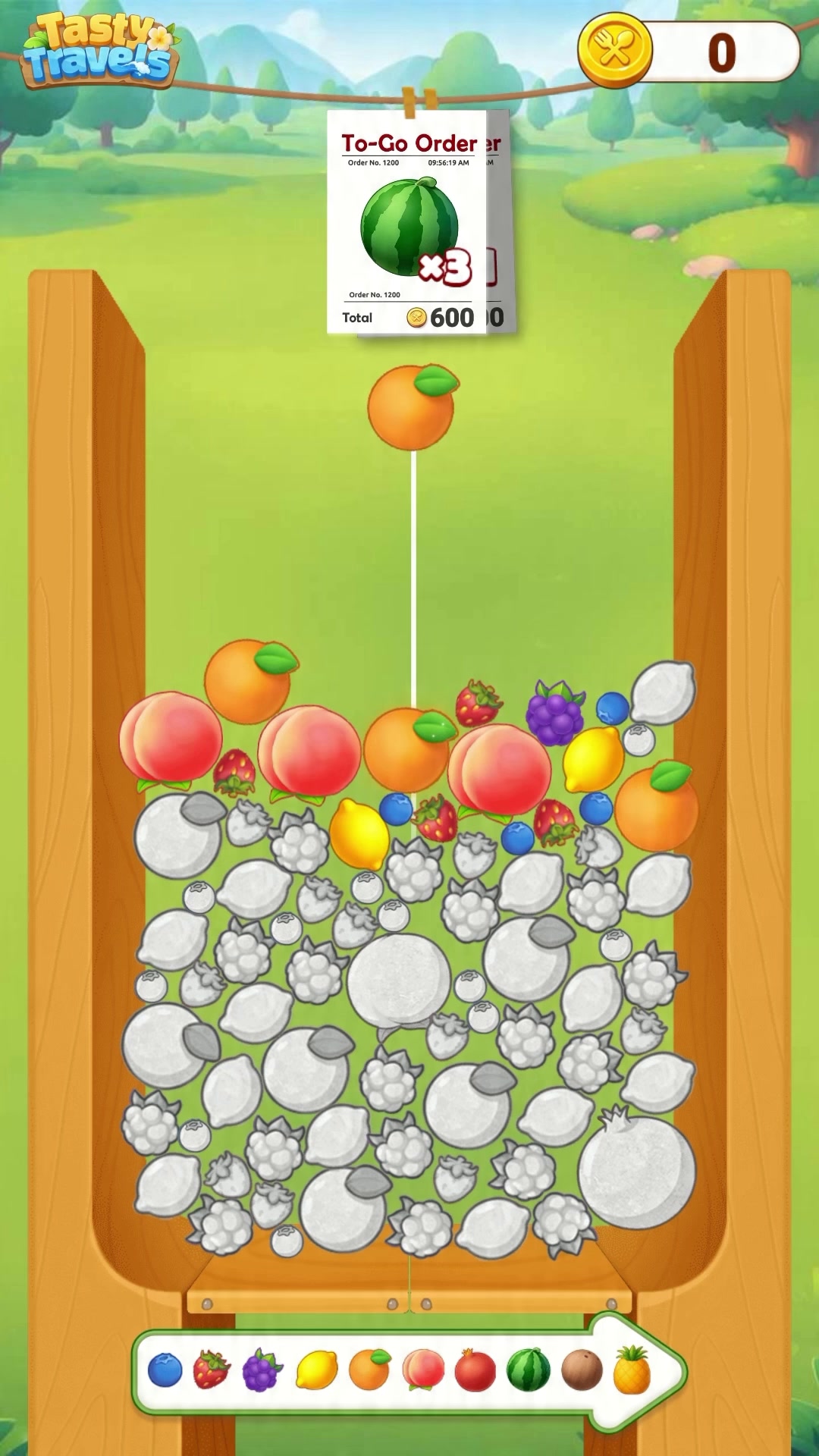
Original Tasty Travels video poster displayed in Denote, recorded October 22. The article describes sampled frames, not a continuous video or gameplay evaluation.
The visible task makes the sequence easier to describe: the viewer has a goal and a place to act. For another game, the equivalent might be a resource shortage or a route that needs clearing. The transferable principle is clarity about the next decision, not the fruit artwork or the order-card design.
The task must also remain readable at the placement's actual size. A production team should check whether the goal, input and response survive a small-screen view without relying on a long caption.
Proposed test: begin with the task or begin with the player action, while preserving the actual mechanic and payoff. Evaluate whether viewers who respond to the ad engage with that same loop in the product.
Lesson 4: Invincible compresses progression into one static comparison
The Invincible image ad places earlier and later character presentations side by side, with visible stats and a play action. Its accompanying copy connects the product to idle battles and resource accumulation.
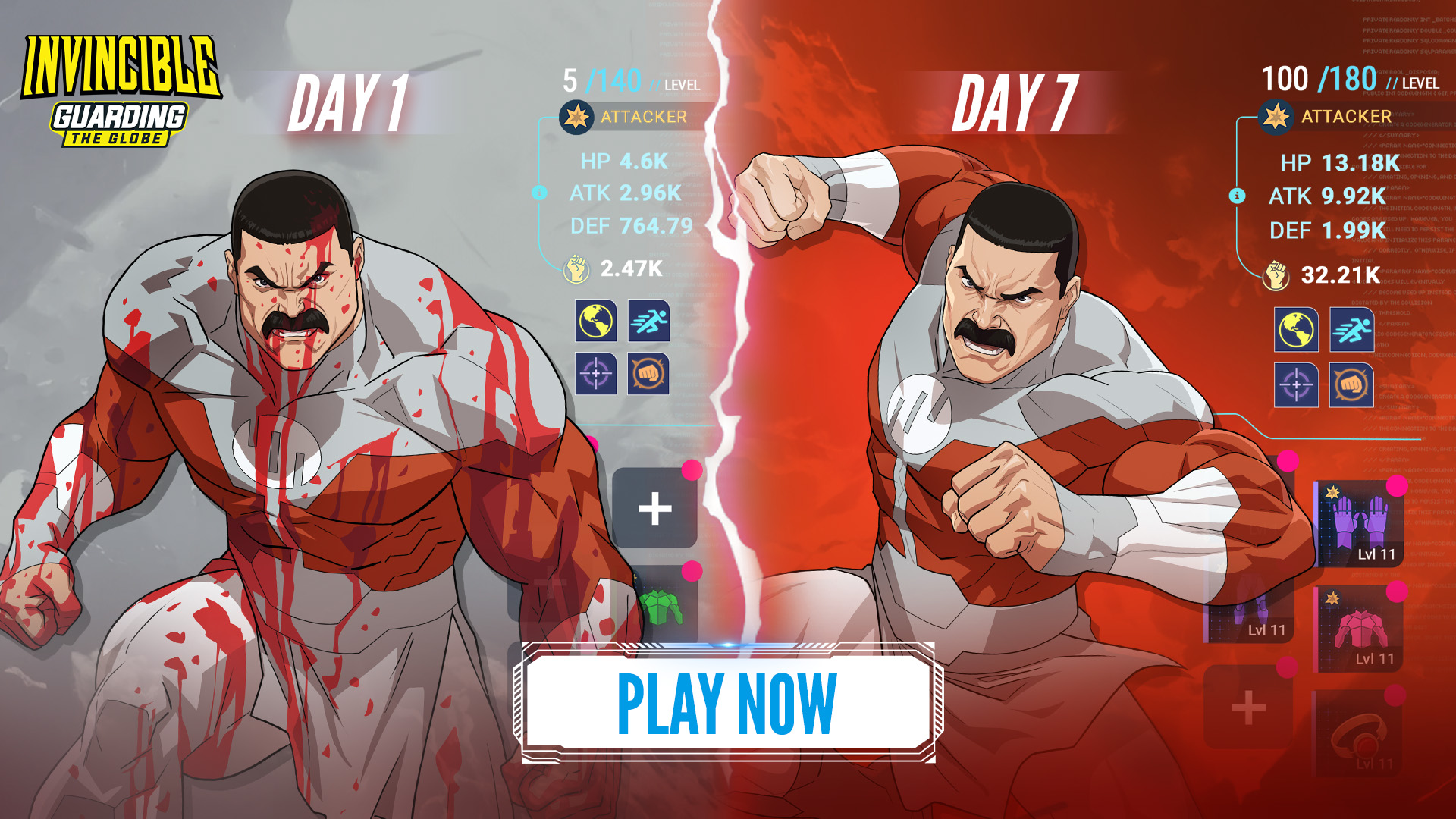
Original image ad displayed in the same week's Game Trending Image view, recorded October 22. The depicted timeline and stats are advertiser claims.
This execution introduces a progression proposition without requiring a video sequence. The comparison is part of the argument: the player is invited to imagine a stronger future state.
The important boundary is evidence. An ad can depict progress without proving that the displayed timeline or resource gains are typical. Your own earlier/later creative needs substantiated states and clear context. Avoid turning an illustrative contrast into a guaranteed outcome.
Proposed test: compare a truthful progression comparison with a single-state character image, holding the proposition, offer and destination consistent. Use your own acquisition and progression data to assess the result.
For a closer look at image construction, see the refreshed static ads guide.
Turn the four lessons into a production brief
Choose the question that fits your current creative problem. These references do not need to become four ads in your next campaign.
Use the ad hooks guide for opening decisions and the ad angle map for the argument behind them. Those are separate briefs: changing a promise is more than changing its first scene.
A practical handoff contains the source creative, observation, proposed interpretation, uncertainty, original adaptation and result to evaluate. Include the intended destination and the game build used to substantiate the promise. The creative analysis worksheet provides a reusable structure.
What this review cannot tell you
One creative does not reveal an entire mobile game marketing campaign. A weekly chart cannot establish the advertiser's targeting, creative experiment, budget allocation, install quality, retention or return on spend.
Likewise, observed duration is not proof of uninterrupted delivery, and a weekly chart date is not the same as the ad's first or last observed date. We did not make a week-over-week comparison or infer that these executions improved since September.
For your own recurring review, keep chart, category, period and filters consistent. Record each creative separately before describing a new variant or a changed signal. The competitor tracking workflow explains that task.
Start with one real creative decision
Open Denote Top Ads, choose Game and a completed week, then inspect the ad behind the thumbnail. Leave with one clearly described decision and an original adaptation your product can support.
FAQs
Are these the four best mobile game marketing campaigns?
They are four selected ad creatives illustrating different decisions. No campaign outcome ranking is claimed.
Can I compare their chart positions to choose a creative style?
Positions reflect the selected chart's measure and scope. They do not isolate the effect of the creative style. Inspect relevance and formulate your own test instead.
Can I reuse the advertisers' footage?
Use the reference to identify a mechanism, then produce original footage and artwork appropriate to your game. The examples here are attributed for analysis, not supplied as reusable production assets.
Method disclosure: this AI-assisted editorial refresh uses recorded Denote previews and source images. Creative interpretations and proposed tests are not advertiser disclosures or measured experiments.


