.jpg)
How to find winning ads is really a question about which creatives deserve your next test. A public ad, a high place on a chart, or a large estimated spend can all be useful leads. None reveals the advertiser's revenue, conversion rate, or return on ad spend. The useful output of research is a short list of creatives with a clear reason to inspect each one—and a test you can run with your own audience.
This guide uses Denote Top Ads for discovery and the Denote Chrome extension inside Meta Ad Library for a closer competitor review. It describes a workflow, not a claim that any example ad generated profitable sales.
TL;DR
- Set the market and creative problem first: category, country, platform, format, and the player or buyer promise you want to investigate.
- Use New Ads to find newly observed executions, Rising Ads to find weekly popularity growth, and Trending Ads to inspect high weekly popularity. Keep their ranks and measures separate.
- Open the creative. Record its first scene, offer or game action, proof, call to action, format, language, and landing destination before judging it.
- In Meta Ad Library, inspect a competitor's active ads and use Denote's running-days, views, and estimated-spend controls to make a shortlist. These are research signals, not verified campaign outcomes.
- Write one creative hypothesis and one measurement plan. Your own campaign data decides whether the idea wins.
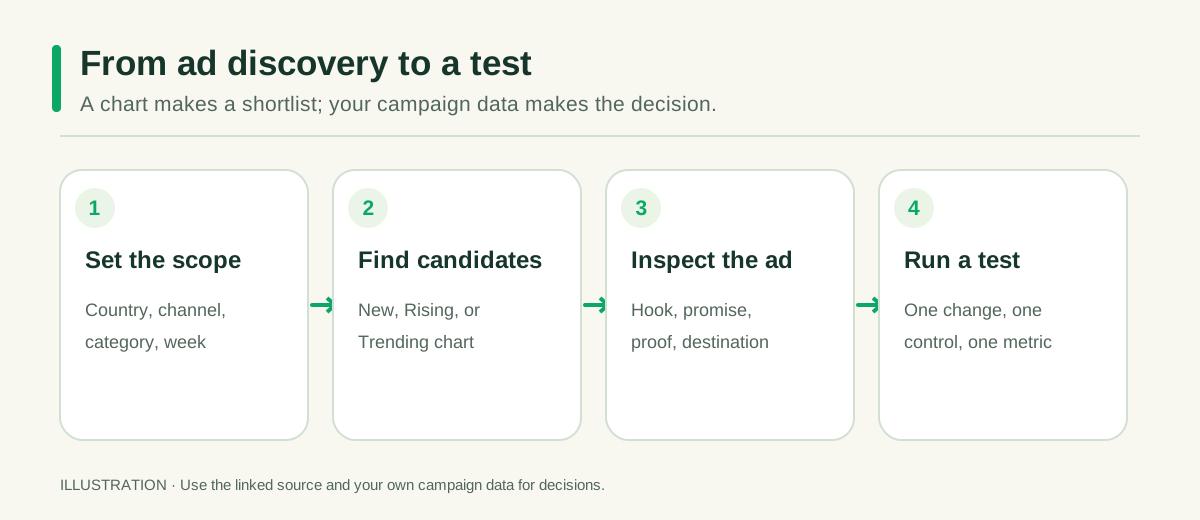
Illustration: the output of ad research is a test brief, not a claim about a competitor's ROAS.
How to find winning ads without assuming a chart proves performance
Start with a question a buyer could act on. “What are the best ads?” is too broad. “Which mobile puzzle ads use a visible problem in the first three seconds?” gives you a defined creative mechanism to look for. Decide whether you need inspiration for an opening hook, a new offer, a format, a market localization, or a landing-page handoff.
Write down the scope before browsing: industry or game genre, target country, platform, language, format, and observation week. Without that scope, a team can mistake a Turkish-language game creative on TikTok for evidence about an English-language Facebook campaign. A useful shortlist compares ads against the same decision, even if the source pages cover different markets.
Denote's three Top Ads views answer different questions:
The Weekly Creative Score is a popularity measure within the selected chart. It is not an impression count or a sales metric. A displayed impression figure is a provider estimate. If a chart is unavailable, record that as missing evidence; do not interpret an empty response as an empty market.
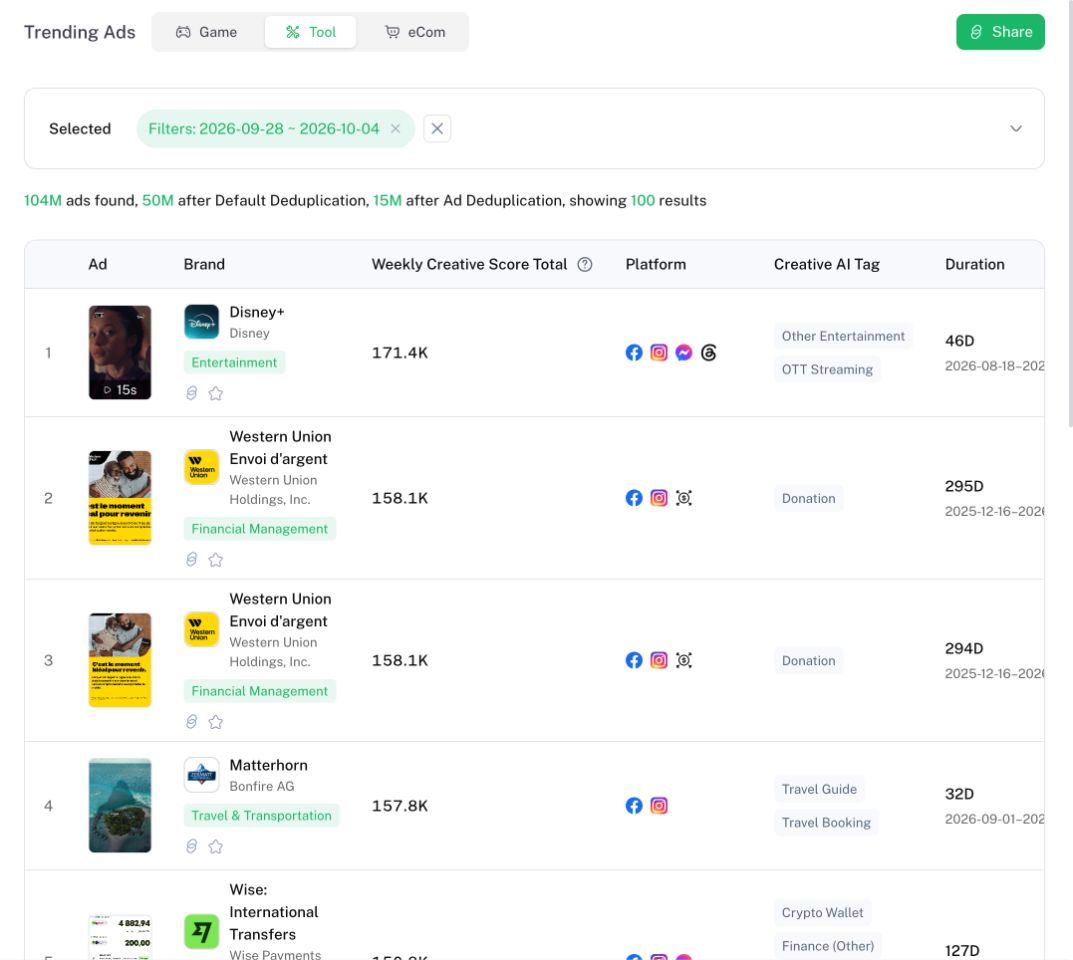
Product screenshot: Denote Trending Ads → Tool for September 28–October 4, 2026, captured October 9. The rank and Weekly Creative Score Total are chart signals; they do not establish ROAS or market size.
What does “winning ad” mean before you have campaign data?
In a research session, “winning” should be a hypothesis, not a verdict. You can say that an ad is newly observed, high on a defined popularity chart, visible over a longer period, or supported by a spend estimate. You cannot say it generated profitable sales unless the advertiser supplies that outcome data. A useful way to find winning ad candidates is to rank them by how relevant their mechanism is to your product and market, then use your own test to decide whether the idea wins for you.
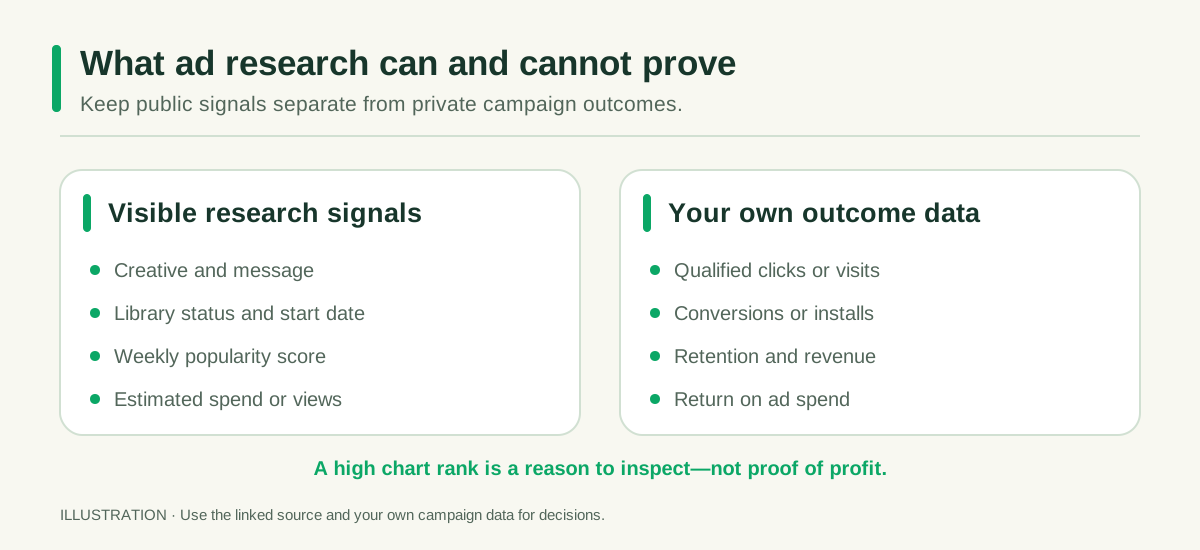
Illustration: public creative signals and private campaign results answer different questions.
Inspect the creative before calling it a candidate
Open a few entries from one completed week, then record what the viewer actually encounters. A useful note contains the first visible scene, on-screen text, product or gameplay demonstration, claim, visual payoff, call to action, and destination. Look for the mechanism rather than the advertiser's artwork: a puzzle with a clear unresolved move, a product demonstration that removes a buying objection, or a comparison that makes the benefit understandable.
Ask whether the promise is transferable to your product. A game ad might show a satisfying mini-game that is not representative of the actual game. A commerce ad might use a licensed character, testimonial, or claim that your team cannot use. Replicating that surface execution is not a sound test. Extract the underlying question—such as whether a visible before-and-after sequence improves comprehension—and create an original version that your product can deliver.
Keep a source link, chart week, filter settings, source rank, and the exact metric name beside each observation. Two ads from different charts should never be ordered in one “top four” list as though their ranks mean the same thing. See our weekly game-ad analysis for an example of selecting creatives from a defined chart rather than claiming campaign ROI.
Three long-tail searches worth turning into research questions
Search terms become more useful when you rewrite them as decisions. For “how to find winning Facebook ads,” ask which active competitor creatives address an objection your product also faces. For “how to find top-performing game ads,” choose a completed Game chart and examine a specific hook or format; the chart indicates popularity, not game revenue. For “how to find new competitor ads,” save a Page watchlist and compare Library IDs and messages on a fixed cadence.
The source changes with the question. Use Denote Top Ads when you need cross-ad discovery, Meta Ad Library when you know the advertiser, and the mobile game competitor-tracking workflow when you need a repeatable Game review. The aim is fewer, better-explained candidates—not a larger folder of screenshots.
Use competitor ads to narrow the research queue
For a named competitor, open Meta Ad Library, choose the country and All ads, then search the advertiser's actual Page. Set Active ads when you want to see what is currently listed. A keyword search is useful for discovering advertisers you do not already know, but it may mix unrelated Pages and meanings. Check the Page identity before adding an ad to a competitor watchlist.
The Denote extension adds a practical second pass inside the library. In the interface checked on October 8, 2026, its filter menu offered Total Spend, Views, Running days, and Ad used; its sort menu offered Total spend, Running days, Views, and Daily spend. The page also showed Show All Ad Spend, Only EU ads, and a Custom CPM control. Availability may depend on the ad, region, and extension access.
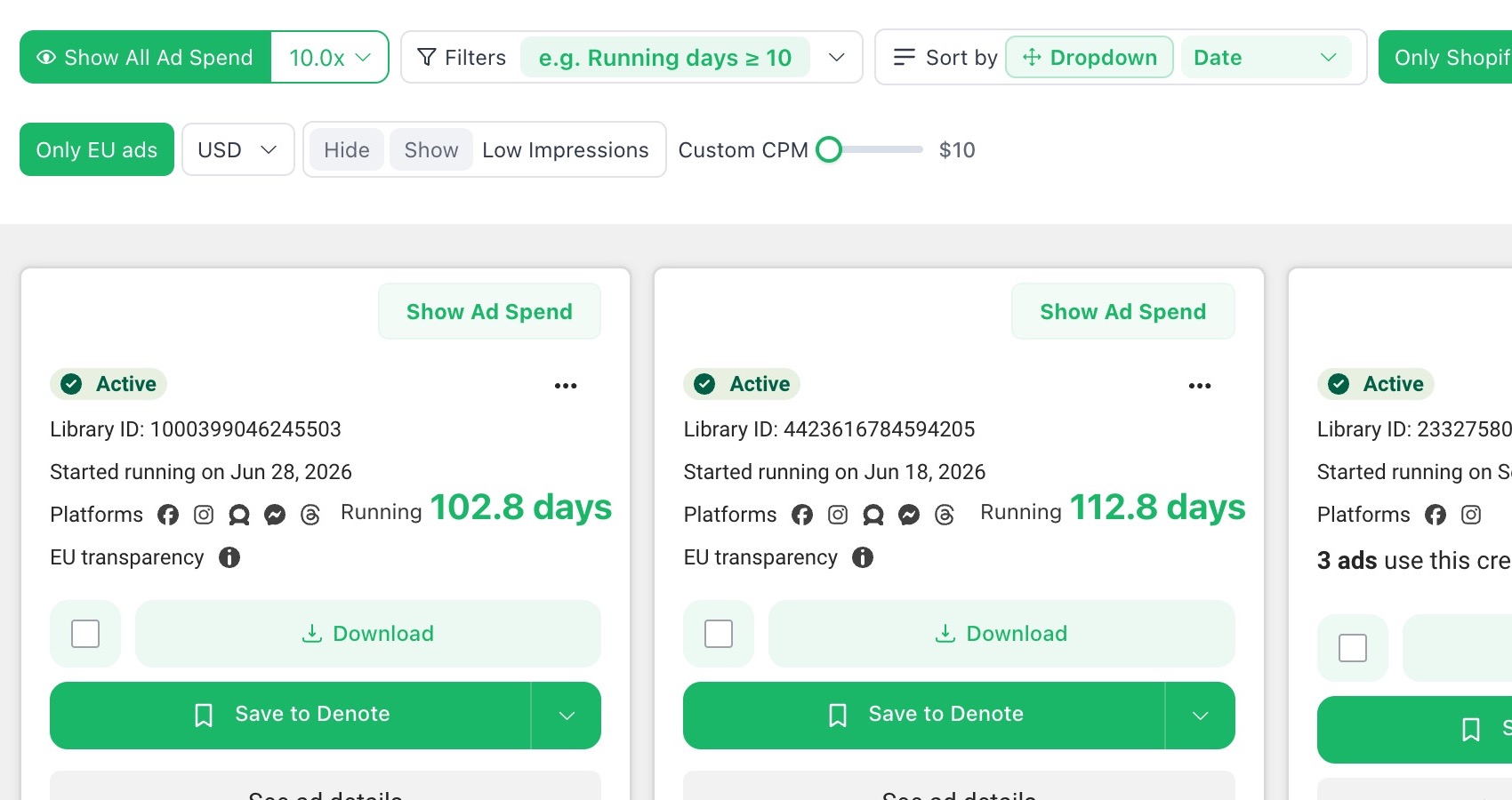
Product screenshot: Denote controls on a Netherlands ugc keyword search in Meta Ad Library, captured October 9, 2026. This is a discovery query; verify the advertiser Page before building a competitor watchlist.
Use these controls to decide which ads to open, not which ads “worked.” For example, filter to a longer observed run, then sort by estimated daily spend to find candidates for a closer review. Recheck the original Meta card, its start date, creative, and landing page. Denote's spend figure is an estimate affected by the tool's assumptions; it is not an advertiser invoice. Our competitor-ad research guide covers the Page-search and watchlist steps in detail, while the Ad Spend guide explains how to interpret the estimate.
Turn one observation into a test brief
A research session should end with a decision. Use this compact brief for each shortlisted creative:
Suppose a newly observed game ad opens with one unresolved puzzle move. The hypothesis is not “this competitor has a winning ad.” It is “showing the player a solvable decision before the app logo may improve qualified store visits for our puzzle game.” Make an original opening that reflects your actual gameplay, compare it with your current control, and judge the result with your own data.
If the idea involves a competitor's character, footage, music, or copy, keep the insight and create your own execution. Research should improve the brief, not become a plan to reuse someone else's creative assets.
Prioritize the shortlist before you produce a new ad
When several ads look interesting, score the fit of the idea, not the apparent success of the advertiser. Give first priority to a mechanism that addresses your current creative problem, appears in your target market or a clearly comparable one, and can be expressed truthfully with your own product. Put a lower priority on an idea that depends on a license, a promotion you cannot offer, or gameplay your app does not have. If two candidates make the same promise, keep the one whose opening and destination are easier to explain.
This creates a practical review queue: inspect now, save for a later question, or discard. The weekly Game creative analysis shows how four observed hooks can lead to distinct test questions without pretending that the source ads share a single performance ranking. For a named brand, use the competitor Page workflow before writing a brief.
A weekly routine for finding winning ad candidates
On the same day each week, review the latest completed Top Ads week with a fixed set of filters. Save a small number of New and Rising candidates and check Trending when that chart is available. Then revisit a named competitor watchlist in Meta Ad Library using the same country and active-status settings. Log what is newly observed, what remains visible, and what has changed in the creative or offer. Absence from a filtered view alone is not proof an advertiser stopped a campaign.
Choose one or two mechanisms to test, not dozens of screenshots to save. Next week, compare the new observations with the same scope and review the results of your own tests. That is how ad research becomes a decision process rather than an inspiration folder.
FAQ: finding winning ads
Can I identify a winning ad from Meta Ad Library alone?
No. The library can show the creative, advertiser, status, and other visible details, but it does not reveal that advertiser's conversions, revenue, or ROAS. Use it to find candidate mechanisms and check them against your own audience. For a Page-first method, read how to find competitors' Facebook ads.
Should I start with New, Rising, or Trending Ads?
Choose by question. New helps find newly observed executions. Rising highlights growth in the chart's weekly popularity measure. Trending shows high weekly popularity in its selected view. Keep ranks and metrics separate. A rising ad is not automatically a new ad, and none of the boards proves profit.
Does a long-running or high-spend ad mean it works?
It is a reason to inspect the creative and offer, not proof of efficiency. A long run can have many explanations, and a spend figure shown by a third-party extension is an estimate. See the Ad Spend interpretation guide before using it in a competitor brief.
How many ads should a media buyer save?
Save only enough to answer the defined question. A short set with source links, dates, comparable filters, hook notes, and a proposed test is more useful than an unlabelled swipe file. If your question changes, create a new shortlist rather than mixing incompatible markets and chart weeks.
How can I use an ad idea without copying it?
Describe the mechanism in plain language—for example, “show the decision before the logo”—then make new footage, copy, proof, and a landing-page handoff that are true for your product. Measure that original execution against a control. Denote Ad Spy can be a starting point for further creative research, but your test data decides the outcome.
Start with Denote Top Ads to find candidates, then use the Denote extension in Meta Ad Library to inspect the competitor context. A candidate becomes a winning ad for your team only after your own experiment supports it.


